A child sorting socks by color is working on their logic. The one pouring water from one glass to another is refining their coordination. The awakening and development of children happen through these ordinary gestures, repeated every day, much more than through sophisticated activities. Understanding what is happening in these moments allows us to support them accurately.
Free movement and floor play: what the WHO recommends for children under five
The WHO’s recommendations for children under five emphasize one specific point: physical activity should be spread throughout the day. This does not mean organizing sports sessions, but rather allowing the child to move freely, often.
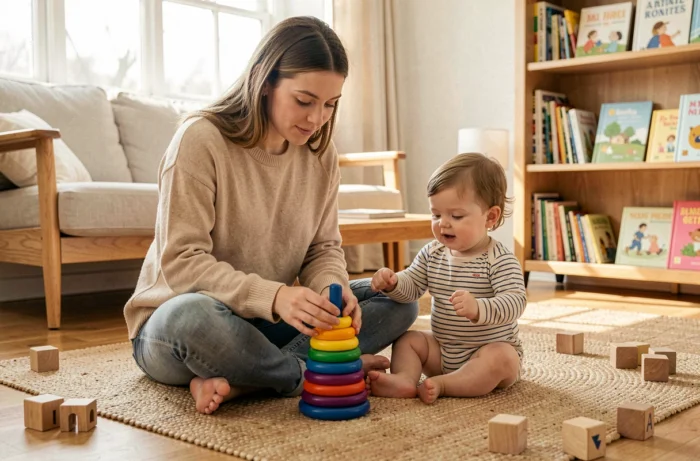
For a baby who is not yet walking, floor play is fundamental. Lying on their back and then on their stomach, they experiment with rolling over, pushing up on their arms, reaching for an object placed just out of reach. These micro-efforts build their musculature and coordination.
For walking children, free movement takes other forms: climbing a slope, running in a park, jumping from a low step. The WHO also recommends limiting the time a child spends strapped in or sitting for long periods, whether in a stroller, car seat, or in front of a screen. This alternation between movement and rest structures physical development as well as concentration.
Have you noticed that a child who has run outside is more easily able to settle down for a calm game afterward? It’s not a coincidence. Movement prepares the brain for tasks that require attention.
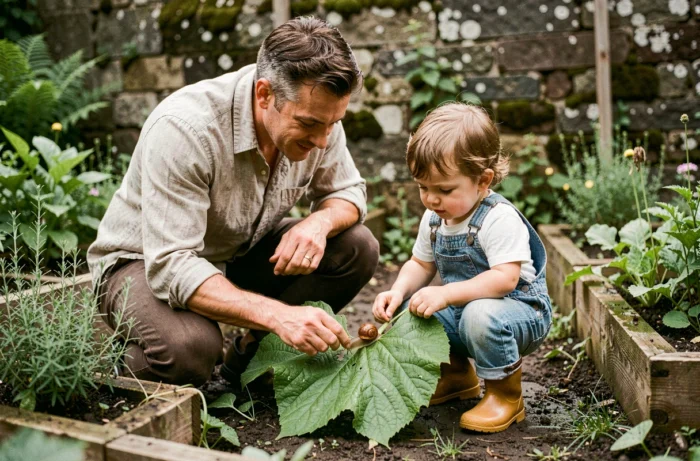
Families looking for ideas for age-appropriate activities can explore the Mes Petits Pas for children website, which offers concrete guidelines to support daily awakening.
Screens and young children: official guidelines to know
The issue of screens is not limited to a matter of opinion. In France, the health record now includes guidelines on screen exposure from the very first pages. Regulations for childcare settings (nurseries, childminders) also govern their use, providing a common framework between home and care settings.
The Enabee study, published by Santé publique France in September 2025, provides data on actual usage. It shows that screen time is higher on non-school days, including weekends and holidays. This observation invites us to pay particular attention to the routines of those days.
Aligning practices at home and in care settings
When a nursery does not use screens and the child encounters one as soon as they return home, the discrepancy can create confusion. Seeking consistency between the two environments helps the child integrate stable references.
In practical terms, this can involve a transition ritual: a calm game, a song, a moment of shared reading. Replacing the screen with a calming activity requires some organization, but the child adapts quickly when the routine is consistent.
Everyday awakening activities: three situations to exploit
No need for specific materials or lengthy preparation. The most mundane moments of the day are opportunities for learning, provided the child is allowed to participate actively.
The kitchen as a sensory exploration ground
Touching the skin of an orange, smelling basil, observing the transformation of a beaten egg: the kitchen engages all five senses simultaneously. A child as young as two can:
- Pour dry ingredients into a bowl, which works on the precision of their movements and the concept of quantity
- Tear lettuce leaves, a fine motor exercise more effective than many educational games
- Name foods by their color, texture, or taste, thereby enriching their vocabulary spontaneously
Cleaning up as a sorting game
Sorting toys by category (animals, vehicles, blocks) or by size introduces logical concepts without formality. Sorting is one of the first cognitive operations that a child masters, well before they know how to count.
Offering bins of different colors transforms cleaning up into a sorting activity. The child associates an object with a category, makes choices, corrects their mistakes. This process engages working memory and decision-making.
Walks as a language support
Walking outside with a child provides a continuous flow of stimulation: sounds, smells, textures, encounters. What makes the difference is the verbal exchange that accompanies these discoveries.
Naming what the child is looking at, reformulating their attempts at words, asking open questions (“What do you hear?”): these interactions build language much more than educational apps. The quality of adult-child exchanges remains the main lever for language development.
Child autonomy: supporting without directing
Letting a child put on their shoes by themselves takes three times longer than doing it for them. Yet, it is in this effort that autonomy is built. The adult’s role is not to constantly stimulate, but to create the conditions for the child to act independently.
Some concrete guidelines for an environment that fosters autonomy:
- Place everyday objects (glass, plate, clothes) at the child’s height so they can help themselves
- Offer limited choices (“Do you want the blue sweater or the red one?”) rather than open-ended questions that paralyze
- Accept imperfect results: a poorly made bed by a four-year-old is a victory, not a failure
- Allow time without directed activity, as boredom encourages the child to invent their own games
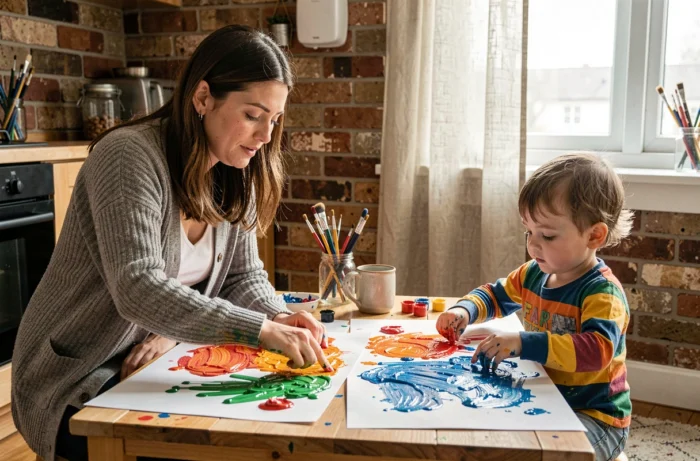
Free play, without instructions or goals set by the adult, allows the child to experiment, fail, and try again at their own pace. It is in these unstructured moments that creativity and self-confidence develop most naturally.
A child’s awakening cannot be scheduled like a timetable. It resides in routines, in silences, in the gestures repeated every morning. The most useful thing a parent can do is to observe what captures their child’s attention and follow that lead, without trying to turn everything into an exercise.