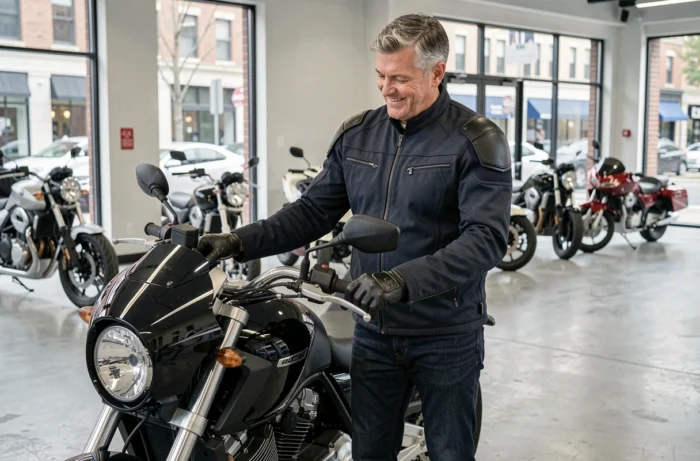
Getting back on a motorcycle at 50 or starting at this age means dealing with physical and regulatory parameters that generic guides overlook. Morphology changes, joint flexibility decreases, and tolerance to vibrations or aggressive riding positions is no longer the same as at 25. Choosing a motorcycle at 50 means first accepting that the specifications have changed.
Motorcycle License After 50: What Regulations Really Impose
Contrary to popular belief, there is no upper age limit for obtaining a motorcycle license in France. A 50-year-old candidate follows the same path as a 20-year-old candidate: A2 license (limited to 35 kW), then A bridge after two years of practice and a supplementary training of seven hours.
The only difference concerns medical fitness. The approved doctor assesses vision, hearing, and joint mobility. After 50, a rigorous medical check-up conditions the validity of the license. A deficit in cervical rotation, for example, can compromise blind spot checks and justify a temporary refusal.
For holders of a B license for more than two years, the seven-hour training (known as the “125 bridge”) allows them to ride a two-wheeler up to 125 cm³ without taking the A2 license. This option is suitable for urban and suburban trips, but it significantly limits the choice of engine size for road and travel. Finding advice on choosing a motorcycle at 50 tailored to one’s profile helps decide between these two paths.
Ergonomics and Riding Position: A Criterion That Engine Size Does Not Summarize
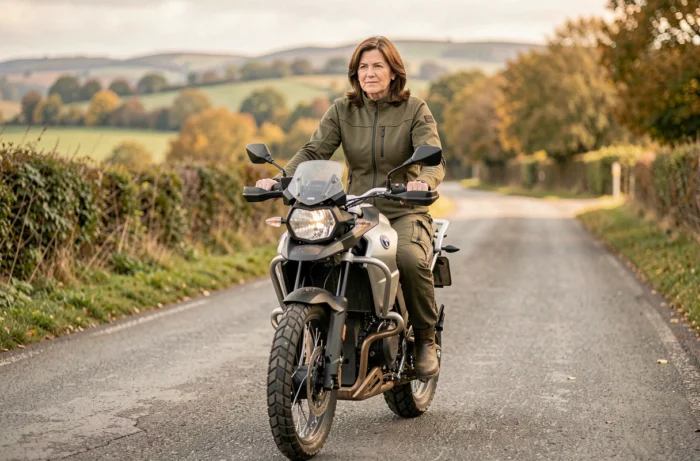
At 50, the back, wrists, and knees dictate the type of motorcycle much more than the engine power. Seat height and weight in running order are the two data points to check as a priority. A seat that is too high prevents the feet from resting flat at a stop, increasing the risk of falling at low speed, especially on wet ground or slopes.
Trail or GT motorcycles place the torso in a vertical position, with arms slightly bent and knees without acute angles. This geometry reduces the load on the lumbar and cervical regions during long trips.
In contrast, sport bikes impose a pronounced bending of the torso and a weight shift onto the wrists. After a few dozen kilometers, this posture becomes uncomfortable for most riders over 45. The roadster offers a compromise: upright position, flat handlebars, but often firmer suspensions than a trail.
Points to Check During a Test Ride
- Both feet should be flat on the ground, knee slightly bent, without twisting the pelvis. If the seat forces leaning to one side, it is too high or too wide
- Check that the controls (brake and clutch levers) can be adjusted in spacing and travel. Fingers that are less flexible than before need a lever that is close and progressive
- Evaluate the actual weight of the motorcycle by lifting it off its center stand. A model over 220 kg requires significant strength for maneuvers at a standstill
Road Safety for Seniors on Motorcycles: An Underestimated Issue
The national road safety plan 2023-2027 identifies seniors as a category whose road mortality is increasing, driven by demographic aging. The share of road deaths among those over 65 is steadily rising, and motorcyclists in this age group are overrepresented in serious accidents.
At 50, reaction time lengthens by a few tenths of a second compared to a 30-year-old driver. This may seem negligible, but at 90 km/h, each additional tenth of a second represents several meters of braking distance.
This reality calls for motorcycles equipped with electronic aids for braking and stability: standard ABS (mandatory on new motorcycles since 2016), anti-skid, and if possible, cornering ABS, which adjusts braking in curves. These systems partially compensate for the decline in reflexes without substituting for the rider’s vigilance.
Personal Equipment: Beyond the Helmet
An ECE 22.06 approved helmet remains the foundation. For a 50-year-old motorcyclist, the weight of the helmet matters more: over 1,500 grams, cervical fatigue sets in quickly on a journey longer than an hour.
An airbag vest (wired or electronic) significantly reduces impact forces on the chest and spine. An airbag vest protects the most vulnerable areas after 50: vertebrae, ribs, and collarbones, whose bone fragility increases with age.

New or Used Motorcycle After 50: Decide Based on Actual Use
The 2023 pension reform has pushed the legal retirement age to 64. For a 50-year-old motorcyclist, this potentially means fourteen additional years of commuting. The motorcycle remains a tool for daily mobility well beyond mere leisure.
Daily use (four to five days a week, all year round) justifies investing in a recent model, with a manufacturer’s warranty, state-of-the-art ABS, and a network of dealers capable of providing maintenance without delay. The acquisition cost is higher, but unexpected expenses remain rare during the first three years.
For exclusive leisure use (weekend rides, summer outings), a used motorcycle under five years old offers a more suitable quality-price ratio. Trail and GT models depreciate significantly after two or three years while maintaining solid mechanical reliability if maintenance has been followed.
- Check the stamped service book and the correspondence between the displayed mileage and the visible wear of the controls, footpegs, and seat
- Request the history of manufacturer recalls and ensure they have been carried out, especially on the ABS braking circuits
- Prefer to buy from a professional who offers a legal compliance warranty, rather than from private individuals without recourse
The choice between new and used also depends on the frequency of winter use. Riding in the rain and salt accelerates the corrosion of cycle parts. A new motorcycle treated for corrosion resistance withstands these conditions better than a used model whose original protection has degraded.
Returning to or starting motorcycle riding at 50 imposes no specific regulatory restrictions but requires prioritizing ergonomics and active safety over power or aesthetics. The right two-wheeler is one that becomes physically forgettable after two hours on the road, not one that attracts attention at a red light.