In 1994, the Parisian and New York runways crystallized deep aesthetic tensions: the babydoll dress as a controversial object, the shift of subversion from black to saturated color, and a French silhouette oscillating between shaped velvet and dry minimalism. We revisit the driving forces that truly structured the wardrobe of this pivotal year.
Babydoll Dress in 1994: A Garment Turned Controversial Object
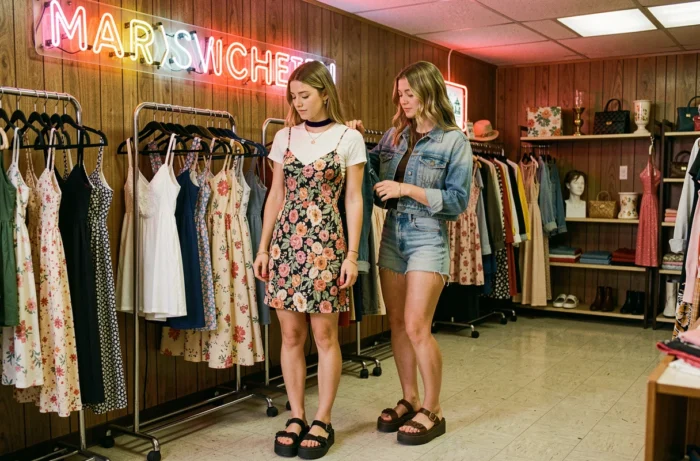
The babydoll dress represents the most revealing point of friction of the 1994 season. Suzy Menkes, fashion critic for the New York Times, describes the trend as “evening gowns with little girl vests and mom’s costume jewelry,” highlighting the “perverse and strange” nature of adult women dressed in children’s clothing.
This is not just a style effect. The babydoll crystallizes a debate on the sexualization and infantilization of female bodies that has never really disappeared. Current discussions around girlhood culture and the appropriation of childlike codes by adult fashion directly extend this controversy that originated on the runways of the mid-90s.
The cut remains technically simple (empire waist, short flared skirt, lightweight satin or silk fabric), but its social reading was already divisive. When we analyze the style and trends of 1994, this tension between displayed innocence and calculated provocation systematically reappears as a marker of the era.
Color vs. Black: The Aesthetic Shift of 1994
Isaac Mizrahi articulated in 1994 an idea that summarizes the stylistic turn of the year: “Wearing black was once the subversive gesture, but it has become obvious. Now, color is truly the provocative thing.” This statement, made in the context of his autumn-winter 1994 collection, is not anecdotal.
1994 marks the pivotal year where subversion shifts from dark aesthetics to color saturation. Grunge, which had dominated since Marc Jacobs’ controversial collection for Perry Ellis in 1992, is losing steam. Designers are seeking another path of rupture, and bright color, worn without irony, becomes this new terrain.
On the Parisian runways, this transition is reflected in collections where shaped velvet and satin appear in bold shades (deep burgundy, forest green, mustard yellow) rather than in the systematic black of previous seasons. The silhouette often remains streamlined, but the fabric speaks.
What This Changes in the Current Wardrobe
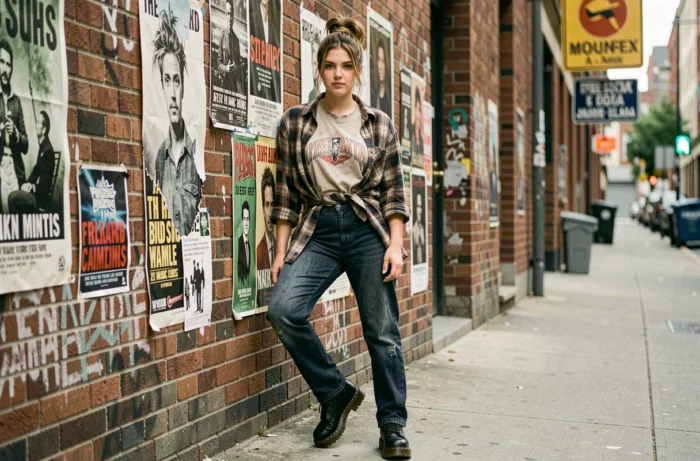
Jeans remain ubiquitous, worn high-waisted with a straight or slightly flared cut. The difference from previous seasons lies in the associations: jeans are worn with a corduroy vest or a colorful crop top, not with a dark flannel shirt. The long printed viscose skirt gradually replaces the grunge tartan skirt.
- Shaped velvet (corduroy or smooth) establishes itself as the transitional fabric between grunge and emerging minimalism, used for both vests and dresses.
- Satin and silk regain a place in everyday ready-to-wear, not just in haute couture, particularly for simply cut evening dresses.
- The crop top, worn with high-waisted jeans, defines the dominant feminine silhouette of the year, long before its resurgence in the 2020s.
Galliano’s Princess Lucretia Collection: A Turning Point for French Fashion
In 1994, John Galliano presented his “Princess Lucretia” collection, a moment that redefined his trajectory and, by extension, that of Parisian haute couture. This collection has durably redirected the career of the British designer.
Galliano imposes in 1994 a radical historicist romanticism that runs counter to the rising minimalism of his contemporaries. The pieces blend Renaissance references, asymmetrical draping, and bias cuts on noble fabrics (silk, taffeta). The bias-cut work, a technical signature of Galliano, reaches a level of complexity rarely seen in luxury ready-to-wear.
This collection places Paris at the center of the global fashion debate at a time when Milan and New York are capturing media attention. It directly paves the way for Galliano’s appointment at Givenchy, then at Dior, two French houses that will dominate the second half of the decade.
The Impact on Street Style in France
Galliano’s romanticism does not directly descend into the street in 1994, but it establishes a stylistic permission. Mixing registers becomes acceptable: pairing a satin dress with flat ankle boots, wearing velvet with denim, layering a structured vest over a crop top. French fashion in 1994 no longer chooses between classic elegance and casualness; it merges the two.
Dominant Silhouettes and Cuts: What 1994 Establishes for the Decade
The feminine silhouette of 1994 is structured around a few technical constants that will persist until the end of the 90s:
- The marked waist returns after several seasons of oversized cuts inherited from grunge, notably through empire waist dresses and high-waisted jeans.
- Shoulders remain natural, without padding, in contrast to the previous decade.
- Length oscillates between very short (mini-skirt, crop top) and very long (midi skirt, floor-length dress), with few intermediate proposals.
- The vest, worn alone or over a basic t-shirt, functions as a transitional piece between formal and casual.
On the men’s side, suits loosen up. The cut of trousers widens, and jackets lose their rigid structure. The world of sportswear begins to infiltrate everyday wardrobes, but 1994 remains a transitional year: streetwear as a distinct fashion category does not yet formally exist in France.
What distinguishes 1994 from the years surrounding it is this coexistence of contradictory directions on the runways and in the street. Minimalism rises, romanticism resists, grunge fades without being replaced by a single current. No movement dominates the season alone, and it is precisely this fragmentation that has left so much room for experimentation.