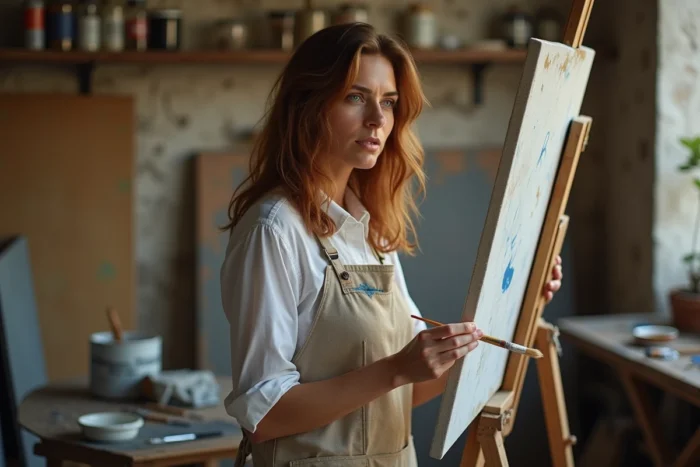
When looking at the paths of contemporary painters, most follow a well-trodden route: art school, residencies, first exhibitions. Béatrice Vonderweidt took a completely different path. A former model, she first existed as a subject in front of the camera before moving behind the easel. This shift from muse to creator is not just a change of profession; it is a complete reversal of the relationship with the image.
From modeling to painting: how the ground changes things concretely
Posing for years forges a keen awareness of light, volume, and staging. One learns to feel a framing, to perceive what a photographer seeks in a posture. This bodily memory of the gaze transfers directly onto the canvas.
Béatrice Vonderweidt did not theorize this transition. She experienced it as a practical necessity: moving to the side of the one who decides what we look at, rather than remaining the object being looked at. To explore in detail the life and works of Béatrice Vonderweidt, it quickly becomes clear that this journey is anything but anecdotal.
Modeling also provided her with a network in the visual field: photographers, art directors, gallery owners met behind the scenes. These contacts facilitate access to initial exhibitions, where many beginner painters struggle to find wall space.
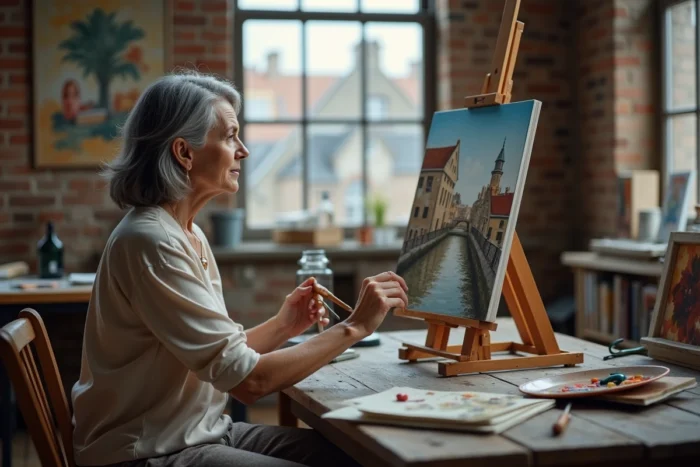
Béatrice Vonderweidt painter: a technique nourished by the body
What distinguishes her pictorial work is the treatment of the human body. Not an idealized magazine body, but a body in tension, in movement, sometimes in resistance. One senses in her canvases an intimate knowledge of poses, muscular balances, and the play of shadows on the skin.
The female figure as a working ground
Her paintings often return to the female figure, but without freezing it in a decorative role. The faces carry a depth, a fatigue, or a determination that contrasts with the smooth imagery of modeling. The subject is no longer an object of seduction but a territory of expression.
This approach resonates with current reflections on the representation of women in the visual arts. A vademecum from the Ministry of Culture specifically addresses the place of women in museums, and how their presence still oscillates between represented subject and recognized creator.
Material and gesture
Béatrice Vonderweidt works with dense materials, impastos that give physical relief to the canvas. We are far from digital flatness. The gesture is visible, embraced, sometimes raw. This materiality reminds us that painting remains a body profession, not just an eye profession.
Status of professional painter: practical constraints
Transitioning from muse to artist is not limited to buying paintbrushes. In France, structuring a professional painting activity involves concrete administrative choices that condition the viability of the project.
- The tax regime for artist-authors imposes specific declarations and social contributions distinct from the general regime, with income thresholds to monitor closely.
- The social protection of artists is evolving: in several French-speaking countries, an official recognition of the status of cultural worker has recently been enacted, opening new rights.
- Access to exhibition spaces is becoming more complicated: contemporary art networks are experiencing a documented fragility described by CIPAC, which outlines a gradual dismantling of the cultural fabric of the territories.
For a former model venturing into painting, these constraints are not theoretical. They determine whether the activity remains an expensive hobby or becomes a true profession.
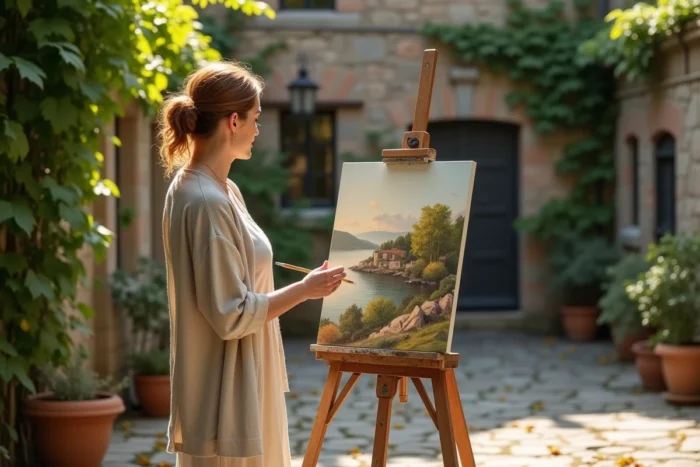
Works of Béatrice Vonderweidt: what we remember when we see them in person
Digital reproductions flatten the work. We lose the textures, the variations in sheen between matte and glossy areas, the grain of the support. Seeing the paintings in person radically changes the interpretation we make of them.
Her compositions play with varied formats. Some small-format canvases concentrate energy on a detail (a hand, a neck), while others, larger in size, create an immersive atmosphere. This choice of formats is not trivial: it directly influences the price, transport, and hanging possibilities in a private setting.
Acquiring a canvas: what buyers look at
In the accessible contemporary art market, private buyers consider several criteria before making a decision:
- The coherence of the artist’s journey, which instills confidence in the sustainability of the value.
- The format and technique, which must correspond to the available space and the lighting of the hanging location.
- The tax exemption related to the purchase of works of art, a lever often unknown to first-time buyers, which allows under certain conditions to deduct part of the amount.
Béatrice Vonderweidt’s atypical journey, from modeling to painting, constitutes a strong narrative element. Collectors find a story that gives meaning to the work beyond its aesthetic qualities.
Muse and painter: a dual perspective on creation
The transition from muse to creator does not erase the first identity. Béatrice Vonderweidt embodies both, and it is precisely this layering that gives her work its uniqueness. She knows what it is to be looked at, and she now knows what it is to construct a gaze.
This dual experience produces canvases that question the boundary between subject and author. One does not look at her paintings in the same way when one knows her story. Modeling is not a youthful accident to forget; it is a material that irrigates each composition.
In a context where exhibition spaces are becoming scarce and the status of artists remains precarious, this type of hybrid journey shows that there are other paths to professional painting. Not easier, but different.