
The loss of curly hair rarely responds to a single cause. Spiral structure, chronic dryness of the fiber, high-tension styling practices: these factors accumulate and make the diagnosis more complex than with other textures. Distinguishing mechanical breakage from follicular loss, and then identifying early warning signs, conditions the entire care strategy.
Centrifugal Central Scarring Alopecia: The Diagnosis That Hair Routines Can’t Fix
A sparse area at the top of the head or crown is not always related to braids or weaves. Centrifugal Central Scarring Alopecia (CCCA) starts precisely in this area and spreads outward. It progressively destroys hair follicles, making the loss permanent if not addressed early.
Signs to watch for: persistent itching at the vertex, burning sensation, localized flakes, or small bumps on the scalp. Short, broken hairs concentrated on the crown can also be an early sign of CCCA, rather than just simple mechanical breakage.
We recommend a dermatological consultation as soon as these symptoms appear. No moisturizing mask or sealing oil can halt scarring alopecia, and a delay in diagnosis turns a reversible situation into permanent loss.
Learning to manage curly hair loss starts with the ability to spot signs that go beyond cosmetic concerns.
Tension and Protective Hairstyles: Tolerance Thresholds of Curly Follicles

Tension is the most documented external factor in curly hair loss. However, the problem is not limited to the application technique: the weight and duration of wear exacerbate tension as much as the initial tightness.
The American Academy of Dermatology recommends not keeping braids for more than six to eight weeks. Significant lengths mechanically increase the force exerted on the follicles, especially at the hairline and temples.
Warning Signs During and After Styling
Pain felt during the creation of a hairstyle is not an indicator of hold. Tingling, scabs, visible tension on the scalp, or headaches after styling signal excessive tension. Pain after styling requires loosening or removing the hairstyle, not waiting for the sensation to subside.
We observe that thinning along the tension line (temples, forehead, nape) points to traction alopecia, while loss centered on the crown suggests CCCA. This distinction guides the choice of treatment.
- Prefer thicker, looser braids at the hairline to reduce follicular pressure
- Alternate hairstyle styles to avoid always stressing the same areas of the scalp
- Limit heavy extensions that increase gravitational tension on already weakened follicles
- Respect periods of hair rest between two protective hairstyles (loose hair, loose twists)
Coexisting Breakage and Loss in Curly Hair: Adapting Care to Each Mechanism
Breakage and loss can coexist in the same hair, but they are treated differently. Confusing the two leads to applying moisturizing treatments to a follicular issue or consulting a dermatologist for simple fiber dryness.
Identifying Mechanical Breakage
A broken hair has an irregular, often angled end. It breaks along the lengths, not at the root. The causes are primarily mechanical: dry detangling, aggressive brushing, repeated heat use, products containing harsh sulfates or drying alcohols.
The care protocol focuses on nourishing and hydrating the fiber. A pre-shampoo with vegetable oil before washing limits water loss. Detangling should be done exclusively on damp hair treated with a leave-in conditioner, from the tips to the roots, using a wide-tooth comb.
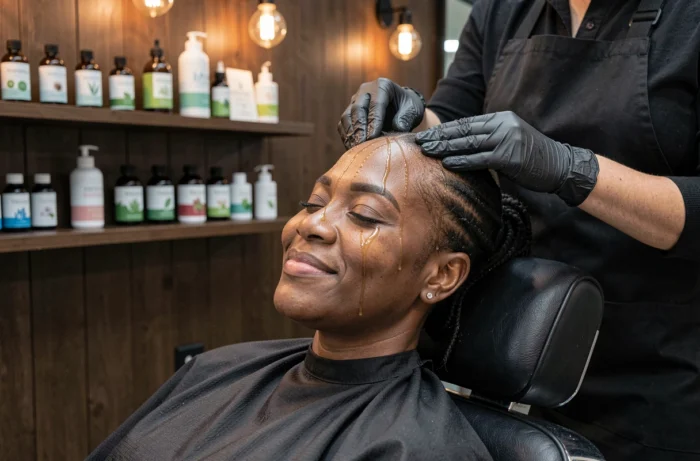
Identifying Follicular Loss
A fallen hair retains its white bulb at the end. The loss concentrates on specific areas (vertex, temples, hairline) or manifests as an overall decrease in density. When loss exceeds normal physiological shedding, possible causes include hormonal imbalance, iron deficiency, stress, or a scalp condition.
The curly scalp requires specific examination because its follicular density and the curvature of the follicle alter the clinical presentation of alopecias. A trichoscope allows visualization of the state of the follicles and guides the diagnosis.
Care for Curly Scalp: Targeted Nutrition and Hydration
The sebum produced by the scalp has difficulty traveling down the spiral of curly hair. This structural peculiarity explains the chronic dryness of the lengths, as well as the tendency of the scalp to accumulate deposits if products are too rich or poorly rinsed.
We recommend gentle washing with a sulfate-free shampoo, spaced according to the individual tolerance of the scalp. A clean and balanced scalp remains the foundation of any anti-hair loss strategy. Allowing product residues to accumulate clogs the follicles and promotes inflammation.
- Massage the scalp with the pads of your fingers (never the nails) during shampooing to stimulate microcirculation
- Apply moisturizing treatments to the lengths and sealing oils while avoiding the roots, unless specifically prescribed
- Protect hair at night with a satin pillowcase or silk bonnet to limit friction and nighttime dehydration
Daily management of curly hair loss relies on this dual approach: monitoring the scalp for any follicular damage and nourishing the fiber to reduce breakage. The two approaches are complementary, never interchangeable. Any localized, painful, or progressive loss deserves dermatological advice, regardless of the existing hair routine.