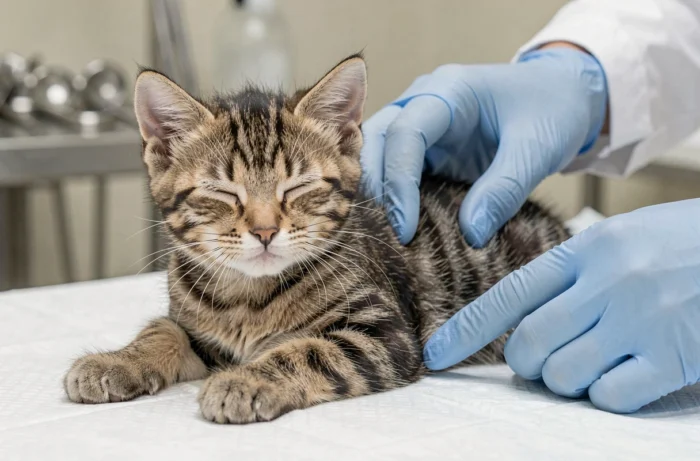
In male cats, the testicles form in the abdomen during embryonic life, near the kidneys. Their migration to the scrotum is a normal stage of kitten development, following a precise timeline. When this process fails, it is referred to as cryptorchidism, a congenital anomaly whose consequences go beyond mere reproductive issues.
Testicular migration in kittens: the mechanism in detail
During gestation, the future kitten’s testicles are held in the abdominal cavity by a fibrous band called the gubernaculum testis. This cord connects each testicle to the scrotum and acts as a guide during descent.
The migration occurs in two phases. The testicle first leaves its abdominal position to reach the inguinal ring, an opening in the muscular wall of the abdomen. It then passes through this canal to reach the scrotum. This journey, spanning a few centimeters, depends on hormonal and mechanical factors.
In most kittens, the descent is completed within the first few weeks of life. By the age of two months, both testicles should be palpable in the scrotum. A detailed article on the subject of the kitten’s testicle at 3 months on AlmAnimal confirms that any absence beyond this period deserves special attention.
A testicle can remain stuck at different points along this path, which determines the type of cryptorchidism diagnosed later.
Abdominal or inguinal cryptorchidism: two distinct situations
Not all cases of undescended testicles are the same. The location of the retained testicle radically changes the diagnostic and surgical approach.

Testicle retained in the abdomen
When the testicle has not passed through the inguinal ring, it remains in the abdominal cavity. External palpation cannot detect it. An abdominal ultrasound becomes necessary to confirm its presence and exact position.
This abdominal form is the most concerning, as the testicle is exposed to an environment with a temperature too high for its normal functioning. Body heat alters spermatogenesis and increases the risk of long-term cellular transformation.
Testicle stuck at the inguinal level
If the testicle has begun its descent but is stuck in the inguinal canal or just under the skin nearby, an experienced veterinarian may sometimes detect it through palpation. Surgical intervention is still recommended, but it is generally less invasive than in the abdominal case.
Unilateral cryptorchidism (one testicle retained, the most common form) is distinguished from bilateral cryptorchidism (both testicles absent from the scrotum, often associated with sterility).
Real risks of an undescended testicle in cats
Cryptorchidism is not limited to an aesthetic or reproductive problem. Three complications justify systematic management:
- Tumor transformation: a testicle retained in the abdominal position is exposed to an unsuitable temperature. This chronic thermal stress promotes the development of testicular tumors, a risk that veterinary sources consider the main reason for recommending surgery.
- Testicular torsion: the testicle not fixed in the scrotum retains abnormal mobility. A torsion of the spermatic cord can occur, causing acute pain and requiring emergency intervention.
- Infertility: in bilateral forms, sperm production is compromised. Even in cases of unilateral cryptorchidism, fertility on the affected side is reduced, justifying the exclusion of the cat from breeding.
The origin of this anomaly is considered hereditary. Breeding a cryptorchid cat transmits the risk to its offspring, reinforcing the recommendation for castration.
When to schedule a veterinary assessment for a suspected kitten
This is the question many owners ask without finding a clear answer: when should one stop waiting for spontaneous descent and consult?
The commonly accepted clinical benchmark places the limit around two months. If at this age one or both testicles are not palpable in the scrotum, a veterinary examination is necessary to locate the retained testicle. Waiting longer generally yields no results, as spontaneous descent after this period remains exceptional in cats.
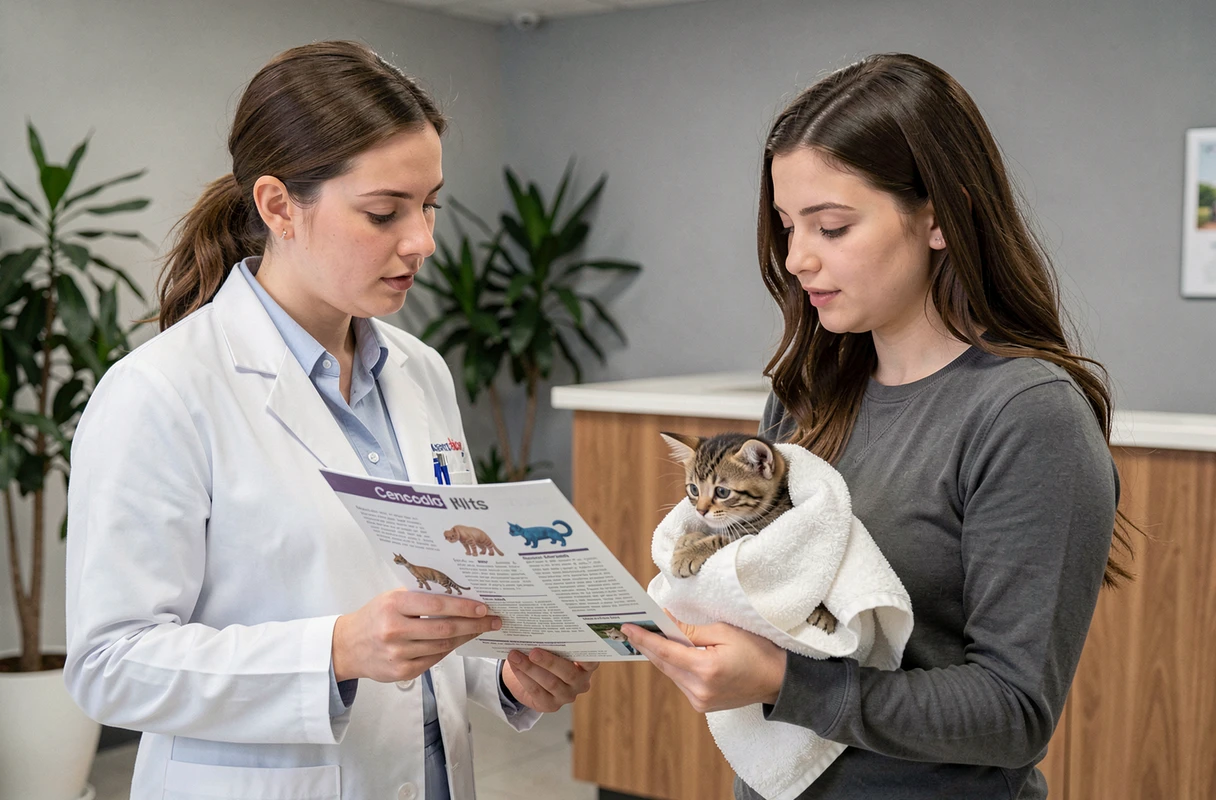
Assessment procedure
The veterinarian first performs a thorough palpation of the inguinal area and the scrotum. In a young kitten, the small size of the anatomical structures can make this examination delicate.
If palpation does not allow for the localization of the testicle, an abdominal ultrasound is prescribed. This imaging examination identifies the exact position of the testicle and guides the choice of surgical technique.
Decision on castration
Castration of a cryptorchid cat differs from a standard castration. Depending on whether the testicle is in the inguinal or abdominal position, the incision and surgical exploration change. The cost of the intervention varies accordingly.
The recommended age for surgery depends on the general health status of the kitten and the location of the testicle. Most veterinarians prefer to intervene around six months, but a healthy kitten can be operated on earlier if the situation warrants it.
Identifying cryptorchidism: what the owner can observe
An attentive owner may suspect the problem even before the veterinary visit. Here are some observation points:
- From two months, visually check and gently palpate to ensure that two small symmetrical masses are present in the scrotum.
- A male kitten exhibiting persistent urine marking behaviors despite an apparent absence of testicles in the scrotum may be cryptorchid: the retained testicle continues to produce testosterone.
- Any asymmetry or absence during palpation justifies a consultation, even if the kitten shows no other symptoms.
Crytorchidism does not cause pain or visible discomfort in daily life. It is precisely this silent nature that sometimes delays diagnosis, while long-term risks – tumor, torsion – increase over time. An early veterinary assessment remains the most reliable approach to protect the male cat’s health in the long term.