An XXL outdoor statue is not chosen like a flower pot. Beyond a certain size, the piece alters the entire perception of the garden: lines of sight, proportions of the flower beds, visual balance from the terrace or the street. Here we address the technical points that most decor guides overlook, from the choice of structural material to anchoring in the ground.
Reinforced fiberglass vs. standard resin: the real criterion for an XXL outdoor statue
Standard polyester resin remains the most common material in the garden sculpture market. It is suitable for medium-sized pieces, but beyond one meter in height, its limitations quickly become apparent: deformation under thermal load, micro-cracks after a few freeze-thaw cycles, UV yellowing in two or three seasons.
Reinforced fiberglass (FRP) offers significantly superior durability for XXL formats. The composite combines a woven glass framework with a resin matrix, providing sufficient structural rigidity to support heights of several meters without internal metal reinforcement. Gel coat type finishes add a layer of protection against moisture, UV rays, and saline coastal environments.
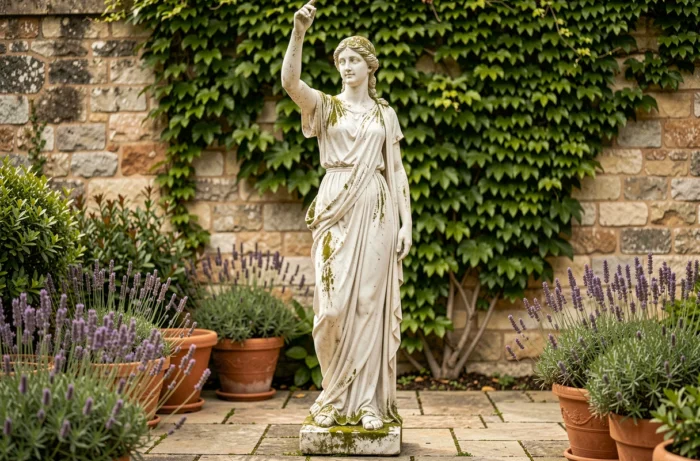
Reconstituted stone remains relevant for an authentic mineral appearance, but its weight complicates handling and requires a concrete base. For those looking for XXL outdoor statues for the garden with a good lightweight-to-strength ratio, reinforced fiberglass is currently the most coherent technical choice.
Ground anchoring and foundation: sizing the support for a large sculpture
Placing an XXL statue directly on the lawn guarantees it will topple at the first serious gust of wind. We recommend treating the anchoring as a small masonry project.
Preparing a stable base according to weight
For a relatively lightweight FRP piece, a shallow poured concrete slab with embedded threaded rods is sufficient in most cases. The slab should extend beyond the base of the statue by at least one footing width on each side.
A reconstituted stone statue requires a thicker footing, poured on a bed of draining gravel. Clay soil, which expands and contracts with moisture, necessitates deeper excavation to prevent the base from shifting over the seasons.
Peripheral drainage
Standing water at the base of the sculpture accelerates degradation, regardless of the material. A simple peripheral drain of gravel or a bed of crushed stone around the base is enough to evacuate runoff water. This technical detail significantly extends the lifespan of the piece.
Placement and sight lines: staging an XXL statue in the garden space
The placement of a large sculpture is not just about finding an empty corner. The piece should function as a focal point visible from the main circulation axis, whether it be the living room’s French doors, the entrance path, or the terrace.
- Leave open space around the statue: a clear perimeter of at least once the width of the piece allows the eye to fully encompass it and avoids a suffocating effect from the vegetation.
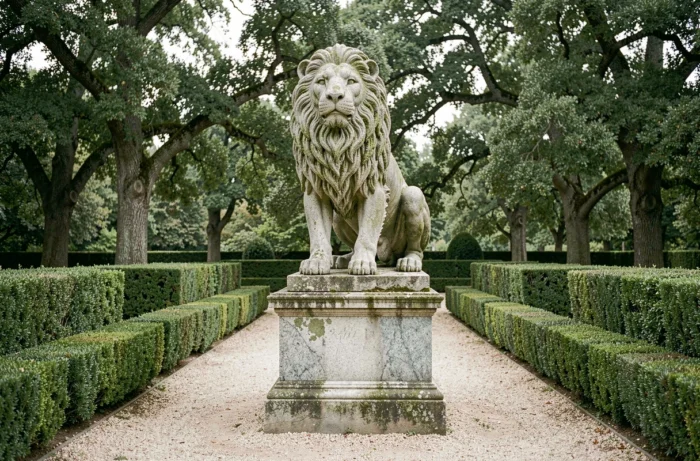
- Place the sculpture at the end of a perspective rather than in the center of a flower bed. A path, a trimmed hedge, or a line of trees that lead the eye toward the piece amplify its impact.
- Test visibility from several points: terrace, upstairs windows, garden entrance. An XXL statue that is only visible from one angle loses half of its effect.
- Avoid multiplying pieces. A single well-placed sculpture structures the space better than three or four scattered elements that fragment attention.
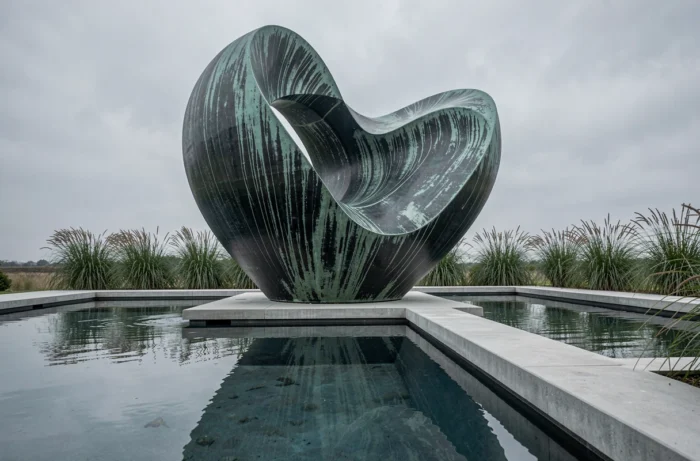
We observe that the most common mistake remains under-sizing. In a large garden, a one-meter statue completely disappears. The piece must be readable from a distance, which implies choosing a size in relation to the depth of the available setback area.
Seasonal maintenance of an outdoor statue in resin or fiberglass
Maintaining an XXL sculpture does not require much time, but it follows a precise schedule to remain effective.
In spring, a wash with clear water and mild soap is enough to remove moss deposits and winter pollution. High-pressure cleaners should be avoided on gel coat finishes: the concentrated jet can damage the protective layer and open the door to water infiltration.
The real winter risk is not the cold but the water that seeps through an existing chip. Before the first frosts, we recommend inspecting the surface for micro-cracks or chips. An epoxy sealant suitable for the material can seal these weak points before the frost worsens them.
For painted or colored statues, a coat of UV varnish every two or three years maintains the intensity of the hues. Brightly colored pieces exposed to full south lose their saturation much more quickly than those placed in partial shade.
Regulations and neighborhood: what large sculptures require checking
A large statue may, depending on its height and location, fall under local urban planning regulations. Local urban planning documents (PLU) sometimes contain clauses regarding decorative elements visible from public roads.
In protected areas, near a historical monument, the reform of surroundings requires consultation with the architect of the Buildings of France for any visible modification to the exterior appearance of a property. Even a garden sculpture can fall within this perimeter if it exceeds a certain height or is within the visibility range of the monument.
Checking the PLU and the heritage protection perimeter before purchase avoids a request for removal afterward. The rules regarding distance from property boundaries, common in neighbor law, also apply to fixed structures installed in the garden.
Choosing an XXL outdoor statue is embarking on a project that goes beyond decoration. The material determines longevity, anchoring ensures safety, placement dictates visual effect, and local regulations set the framework. Addressing these four points upfront transforms an impulsive purchase into sustainable landscaping.