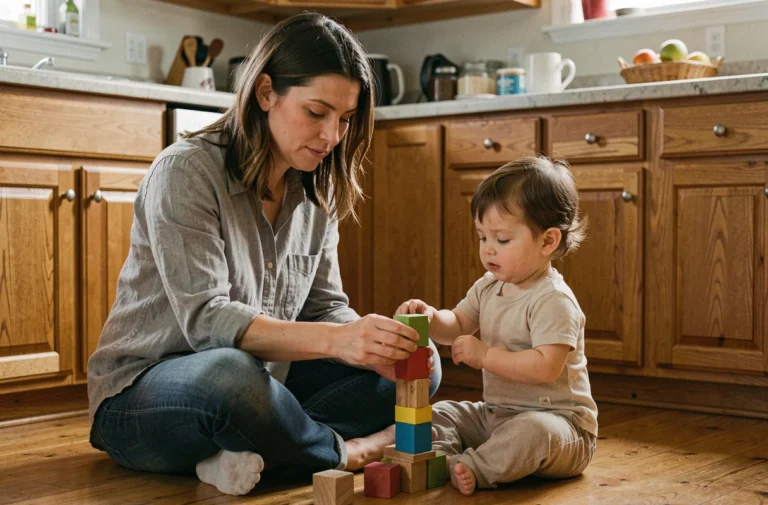
The evening meal turns into a power struggle, backpacks lie around in the entrance, and no one knows who was supposed to take out the trash. These repeated micro-tensions weigh more on the family climate than major occasional crises. Building a thriving family life on a daily basis relies less on grand principles and more on concrete, repeated, sometimes tiny adjustments.
The family council: an underestimated mediation tool
Have you ever noticed that the same topics keep coming up without ever being resolved? Who cleans the kitchen, who takes the kids on Wednesdays, who decides the weekend plans. These unresolved questions add to the mental load of each parent.
The family council is a short weekly meeting, set at a specific time. Each member, including children, can express a need, a disagreement, or a suggestion. The format is simple: a round of speaking, listening without interruption, and then a joint decision noted somewhere visible.
What distinguishes this meeting from a simple discussion is its regularity. A one-off exchange after a fight does not have the same effect as an expected and predictable framework. Children learn to articulate what bothers them without waiting for tension to rise.
Parents, on the other hand, sometimes discover frustrations they hadn’t perceived. Numerous resources on parenting and family organization are gathered on the family section on mrseb.fr, which addresses these issues from a practical angle.
A regular family council reduces conflicts before they escalate. It is not a court: no one is judged there. It is a space where the rules of life are built together, making them much easier to respect.

Division of household tasks: overcoming the constant ambiguity
Family organization rarely runs smoothly when responsibilities remain implicit. The parent who “sees” what needs to be done ends up carrying the majority of the mental load, while the other waits to be asked.
Making tasks visible and assigned changes the dynamics of the household. A magnetic board on the refrigerator, a shared list on a phone, it doesn’t matter what the medium is. What matters is that each task has an identified person responsible for it for the week.
Involving children according to their age
A four-year-old can put their plate in the sink. An eight-year-old can prepare their backpack alone and fold simple laundry. A teenager can manage one meal a week.
- Before six years: symbolic gestures (putting away shoes, watering a plant) that instill the reflex of contribution
- Between six and ten years: regular responsibilities with light follow-up (setting the table, sorting laundry by color)
- From eleven years onwards: autonomous tasks with an expected outcome, without constant supervision (grocery shopping, cleaning a room)
The goal is not to turn children into little housekeepers. It is to give them the concrete feeling that they participate in the functioning of the household, which reinforces their place in the family.
Screen time in the family: establishing a shared framework rather than prohibitions
Conflicts related to screens are among the most frequent tensions in households with children. The problem rarely comes from the screen time itself, but from the absence of clear rules or the inconsistency between what parents demand and what they practice.
Digital rules that also apply to adults are much better accepted. If phones are banned at the table for children but the parent checks theirs, the rule loses all credibility.
Screen-free time slots, an effective ritual
Rather than counting minutes of use, a simpler approach is to define screen-free periods for the whole family. The evening meal is the most natural time slot. The time between returning home and dinner works well too, especially with young children.
During this time slot, phones are stored in a specific place (a drawer, a basket in the entrance). This physical action helps break the reflex to check them. Putting the phone in a fixed place is better than promising not to look at it.

Decluttering and serenity: the effect of family minimalism
A living room saturated with toys, an entrance cluttered with out-of-season coats, cupboards that are no longer opened out of discouragement. The accumulation of objects in a household with children progresses quickly and generates daily visual fatigue.
Regular decluttering (not a big annual sorting, but a monthly pass through each room) produces a measurable effect on domestic stress. Fewer objects mean less tidying up, fewer disputes over messiness, and more functional living spaces.
- Start with duplicate or broken items, which require no hesitation
- Involve children in sorting their toys by letting them choose what they want to give away
- Apply a simple rule before each purchase: one item in, one item out
- Clear a visible surface in each room (a table, a countertop) and keep it empty at all times
A clear space reduces the mental load related to tidying up. It is not a question of aesthetics, but of daily functioning. When each object has a defined place, tidying up becomes a quick gesture instead of a postponed chore.
Shared moments in the family: quality over quantity
Spending time together does not mean organizing spectacular outings every weekend. The moments that build family bonds are often short and ordinary: preparing a meal together with a child, taking a ten-minute walk after dinner, reading a story without rushing.
A shared moment of twenty minutes with complete attention is worth more than a distracted afternoon. The difference lies in real availability, not duration.
Activities do not need to be planned to count. A spontaneously taken card game, a conversation in the car, an unexpected fit of laughter while doing the dishes. These micro-moments, repeated, create the sense of belonging that children remember long after childhood.
Building a thriving family life on a daily basis requires neither a special budget nor a sophisticated method. A regular discussion framework, visible responsibilities, controlled screen time together, and a lightened environment are enough to transform the atmosphere of a household in just a few weeks.