
The handing over of the keys after the signing at the notary marks the effective transfer of ownership of a property. In the majority of transactions, the buyer leaves with the keys on the same day. However, this standard scenario hides several lesser-known configurations, where the handover is delayed, anticipated, or even blocked. Understanding these variants helps avoid legally risky situations.
Escrow, reservations, and occupation: what can delay the handover of keys
The most common case of delay concerns the deferred handover of keys after signing. The seller has not yet vacated the property, often because they are waiting for the completion of another purchase. In this configuration, a portion of the sale price may be held by the notary in an escrow account, serving as financial security until the property is effectively vacated.
The opposite situation also exists. An early handover of keys after notary signing, that is, before the signing of the authentic deed, exposes both the buyer and the seller to distinct risks: damage to the property, cancellation of the sale, or difficulties in eviction if the occupant refuses to leave.
To secure an early handover, a specific agreement must detail the date, duration of occupation, permitted use, financial compensation, and allocation of charges. Without this document, occupation without an authentic deed remains legally precarious.

Comparison of key handover scenarios: timelines and guarantees
The three main configurations for handing over keys do not offer the same level of protection to the parties. The table below summarizes their characteristics.
| Scenario | Time of handover | Guarantee for the buyer | Guarantee for the seller | Required document |
|---|---|---|---|---|
| Handover on the day | Right after signing the authentic deed | Immediate transfer of ownership | Full payment received | Sales deed |
| Deferred handover | From a few days to a few weeks after signing | Partial escrow of the price | Time to vacate the property | Clause in the deed + notarial escrow |
| Early handover | Before signing the authentic deed | Access to the property in advance | Low (risk of non-sale) | Precarious occupation agreement |
The scenario of the day remains the safest for both parties. In contrast, the early handover presents a clear imbalance: the seller bears most of the risk since they lose control of the property before having received the price.
Handover of keys in VEFA: three distinct stages not to be confused
In new real estate sold in a future state of completion (VEFA), confusion is common between three moments that do not have the same legal significance.
- The pre-delivery visit allows for checking the progress of the work and identifying any defects before the official handover, without contractual value of acceptance.
- The acceptance of the work formalizes the completion of the program and triggers the legal guarantees (perfect completion, biennial, ten-year).
- The actual handover of keys occurs after the payment of the balance, which is the last 5% of the sale price in VEFA, conditioned on the confirmed compliance.
After receiving the keys in VEFA, the buyer has one month to report any apparent defects not noted during delivery. This period starts from the effective possession of the property.
Reservations and withholding of the balance in VEFA
If reservations are made at delivery (non-compliant finishes, missing equipment), the buyer can withhold the balance with a third-party organization rather than paying it directly to the developer. This withholding ensures that corrective work will be carried out.
In a contract for the construction of an individual house (CCMI), a clause that makes the handover of keys conditional on full payment of the price can be contested, especially when it prevents the project owner from withholding the balance in the presence of reservations.
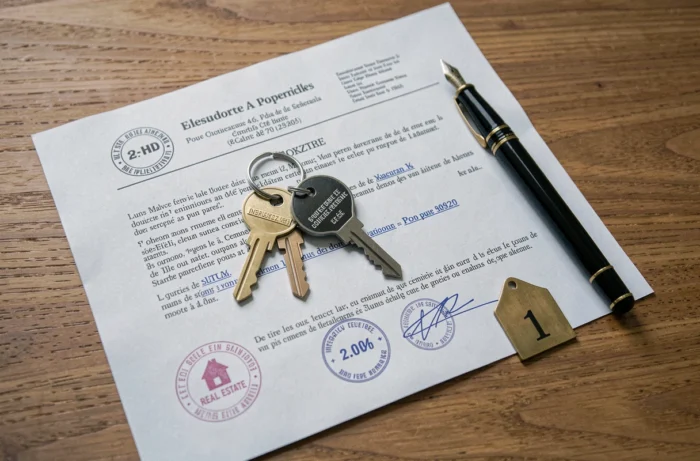
Refusal to hand over keys: concrete remedies for the buyer
A seller who refuses to hand over the keys after the signing of the authentic deed finds themselves in a situation of contractual non-performance. The transfer of ownership having already taken place, the buyer is legally the owner.
- The first step is to have the refusal noted by the notary, who can send a formal notice to the seller.
- If the seller remains in the property, the buyer can initiate eviction proceedings, but this must go through a court decision.
- The notary may also have included a penalty clause in the deed, providing for a daily indemnity in case of delay in vacating.
The presence of a escrow clause in the sales deed simplifies the situation: the withheld funds exert direct financial pressure on the seller to vacate the property within the agreed timeframe.
Precarious occupation agreement: what it must contain
When the handover of keys does not coincide with the signing, whether it is early or deferred, the precarious occupation agreement becomes the reference document. It must specify the date of entry into the premises, the maximum duration of occupation, the strictly permitted use, the amount of any occupation indemnity, and the allocation of current charges.
Without this agreement, a dispute over the condition of the property or the departure date becomes difficult to resolve. The notary drafting the deed is best placed to integrate these clauses directly into the compromise or in a dedicated amendment.
The most protective configuration remains the handover of keys on the day of signing, with full payment and simultaneous transfer. Any other configuration introduces a gap between legal ownership and physical possession of the property, which mechanically generates a risk for one of the two parties.