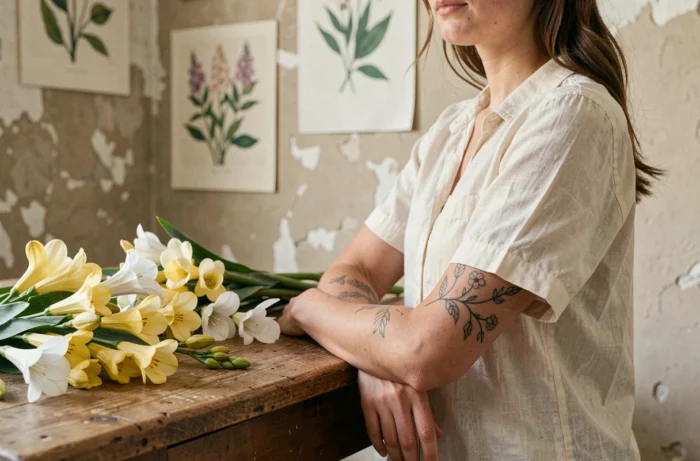
The freesia is one of those flowers that is first recognized by its fragrance, even before identifying it visually. A bulbous plant native to South Africa, belonging to the Iridaceae family, it produces fine, arching flower stalks bearing clusters of flowers in an open corolla. In tattooing, the freesia holds a special place: its elongated shape, flared petals, and flexible stem offer a graphic silhouette that is immediately recognizable, distinct from roses or peonies.
Tattooed freesia: a floral morphology that dictates style
The botanical structure of the freesia directly influences its representation in tattoos. Unlike a round and compact flower, the freesia features a stalk where closed buds and fully bloomed flowers coexist, cascading along a slightly curved stem. This vertical architecture is particularly suited for long and narrow placements: forearms, sides of the calves, flanks, or along the spine.
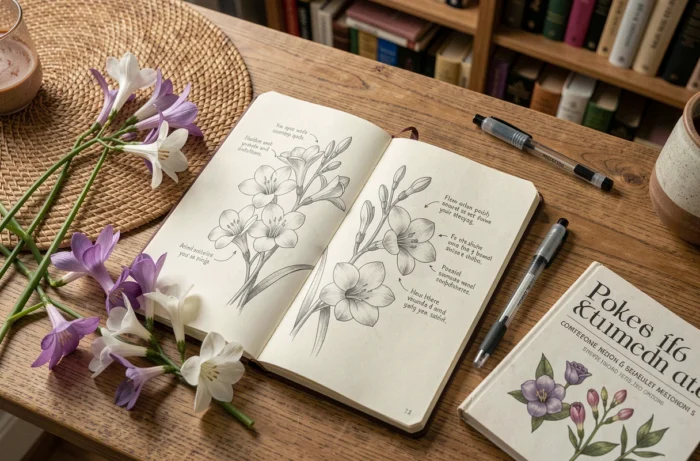
Specialized fineline tattoo artists exploit this shape to create compositions where several freesia stalks intertwine without overwhelming the skin. The corolla with six tepals, widely open when the flower is in bloom, allows for a play of fine lines that works well in both black and gray as well as in color. The result is a pattern that remains legible even in small sizes, which is not the case for all flowers.
A rarely discussed point: the freesia in bud, still closed, has a very different appearance from the open flower. Some choose to mix the two stages in the same tattoo to evoke a progression, a transition from one state to another. This botanical peculiarity, specific to stalked flowers, gives the freesia a narrative capacity that solitary flowers (like the lotus or daisy) do not naturally offer.
To delve deeper into the meaning of the freesia in tattoos, one must go beyond mere aesthetics and examine what this flower conveys as a message in different cultures.

Symbolism of the freesia: trust and friendship above all
The traditional symbolism of the freesia revolves around trust, sincere friendship, and delicate thought. Recent floral guides place these notions at the forefront, ahead of the more generic themes of youth or purity found in many online contents.
This distinction matters for the choice of a tattoo. A person wishing to honor a deep friendship or a family bond built on trust will find in the freesia a more precise symbol than a cherry blossom (ephemeral) or a rose (passionate). The freesia expresses a lasting attachment without obligatory romantic connotation.
On the other hand, field feedback diverges on this point: some tattoo artists also associate the freesia with the idea of a new beginning or personal rebirth, especially when tattooed alone, without other floral elements. The boundary between these interpretations remains blurred, and it is often the intention of the tattooed person that determines the definitive meaning of the design.
Color of the tattooed freesia and associated meaning
The freesia exists in an extensive palette (white, yellow, pink, purple, red, orange), and each color carries a distinct meaning that directly influences the choice of the design.
- White freesia in tattoo: evokes sincere commitment, a new beginning, or a desire for honesty towards oneself or someone else. It is the most understated version, often chosen in black and gray fineline.
- Yellow freesia: celebrates a warm friendship or a bright family relationship. Yellow in tattoos ages differently depending on skin types, which merits discussion with the tattoo artist before proceeding.
- Pink freesia: often chosen as a discreet tribute to a maternal figure or tender affection. Pale pink in realistic tattoos requires particular technical skill to remain visible over time.
- Purple or red freesia: carries a more intense emotional charge, related to passion or a significant memory. These saturated shades generally hold better on the skin than lighter colors.
The choice to tattoo the freesia in color or in black and gray is not solely aesthetic. It alters the symbolic reading of the design. A monochrome freesia leans towards graphic elegance and leaves the meaning open, while a colored freesia anchors the tattoo in a more precise intention.
Placement and size of the freesia tattoo: technical constraints
The stalk shape of the freesia, with its succession of flowers along a curved stem, imposes constraints that other floral designs do not. A very small freesia (less than five centimeters) risks losing the legibility of its open petals over the years. Tattoo artists generally recommend a minimum size sufficient for each flower in the cluster to remain distinct after healing.
Locations that follow the natural curvature of the body work better for this design. The inside of the arm, along the ribs, or behind the ear (for a minimalist version with a single flower) are areas where the arched stem of the freesia conforms to the morphology without distortion.
A technical aspect to consider: the fine lines characteristic of the fineline style, very popular for freesia tattoos, require rigorous maintenance during healing. Ultra-fine lines are more sensitive to friction and sun exposure during the first weeks. This is not a deterrent, but it is a factor to integrate into the choice of placement.
Freesia alone or in floral composition
The freesia combines well with other flowers in tattoos, but it also works perfectly on its own. In a composition, its elongated silhouette often serves as a guiding line around which rounder flowers (roses, peonies) are organized. Alone, it retains a discreet elegance that avoids the “bouquet” effect sometimes criticized in heavily floral tattoos.
The freesia combined with non-floral elements (butterflies, moon, handwritten text) remains legible because its shape does not saturate the visual space. This is an asset for those who wish for an evolving tattoo, complemented over time by other elements.
The choice of the freesia in tattooing rests on a balance between a distinctive graphic aesthetic and a symbolism centered on trust and lasting attachment. Its botanical form, its color palette rich in meaning, and its ability to adapt to different styles (fineline, realistic, minimalist) make it a floral motif that deserves consideration beyond mere trend.