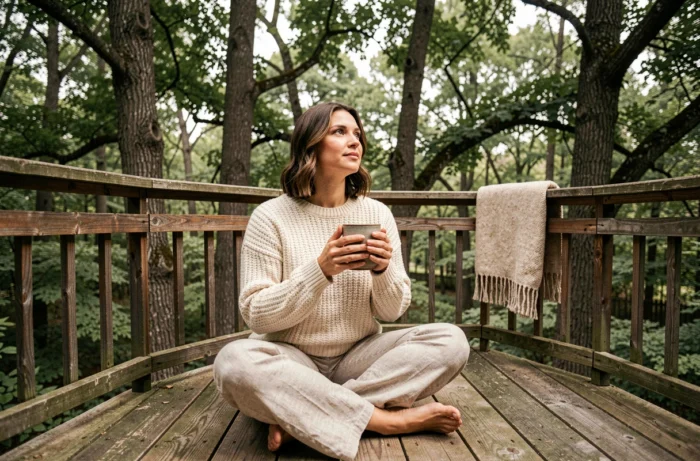
A nature accommodation refers to any place of stay designed to integrate with the surrounding natural environment, whether it be a treehouse, a yurt, a lodge, or a tiny house. The common thread among these structures lies less in their form than in their promise: to sleep in a setting where the boundary between indoors and outdoors blurs.
Thermal comfort and sound insulation: what distinguishes a good nature accommodation
Online selections highlight architectural originality, photos of Nordic bathtubs, and panoramic views. The criterion that determines the actual quality of the stay is more prosaic: thermal comfort and sound insulation.
A poorly insulated treehouse becomes difficult to bear as the nights grow cooler. A glass-walled lodge without passive ventilation turns into a sauna in the summer. Recent field feedback emphasizes these points often missing from commercial descriptions.
Before booking, several elements deserve direct verification with the host or in detailed reviews:
- The presence of a private bathroom rather than a shared sanitary block several dozen meters away
- The type of heating (wood stove, electric convector, total absence) and the actual operating period of the accommodation
- The cancellation policy, which varies significantly from site to site and can impact the budget in case of bad weather
- Accessibility for people with reduced mobility, rarely mentioned even though it conditions the stay for a significant portion of travelers
Browsing the accommodations on Terres d’envies allows filtering these practical criteria even before envisioning a setting.
Cabin, yurt, tiny house: legal status and consequences for the traveler
The diversity of nature accommodations masks a complex regulatory reality. The unusual nature does not create any specific legal regime. A yurt equipped with a floor, a stove, and furniture is no longer simply camping: it shifts to the regime of light recreational dwellings (HLL) and remains subject to the urban planning code.
For tiny houses, the situation is similar. A tiny house fixed to the ground may require prior declaration or a building permit depending on its size and location. The local urban planning plan (PLU) of the municipality determines what is permitted, zone by zone.
What this concretely changes for the stay
An accommodation operated outside authorized zones may be subject to a municipal order, which sometimes leads to closures during the season. Checking that the place is listed on a recognized platform or has a registration number reduces this risk.
Safety obligations (fire detection, emergency exits, electrical standards) apply regardless of the type of structure. A compliant accommodation protects as much as it reassures, and serious operators do not hesitate to display their certifications.
Glamping and eco-lodge: two approaches to nature stays that should not be confused
The term glamping (a contraction of glamorous and camping) refers to an offer where hotel comfort is established in a natural setting: quality bedding, electricity, sometimes a private spa. The eco-lodge takes the logic further by integrating a verifiable environmental approach: bio-sourced materials, water management, partial energy autonomy.
Glamping prioritizes comfort, while the eco-lodge adds ecological coherence. The two can coexist in the same domain, but the commitments are not equivalent.
Identifying a credible eco-lodge
The absence of a unified label makes reading difficult. A few signals help to sort: the mention of labels such as European Ecolabel or Green Key, transparency about the origin of construction materials, and the presence of a carbon footprint or impact report, even if simplified.
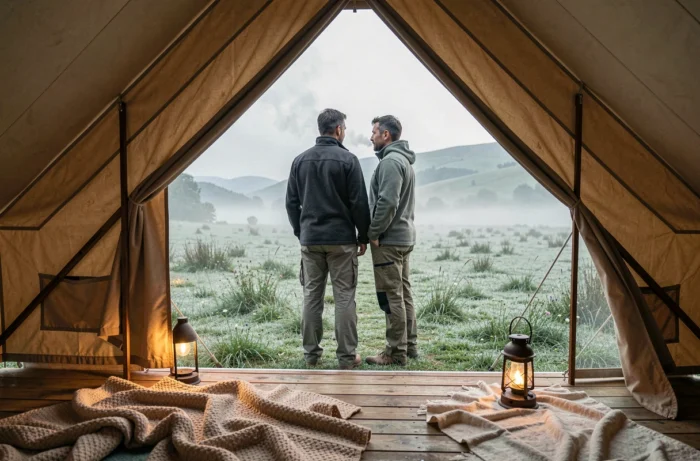
A domain that merely sets up safari tents in the middle of a meadow and declares itself “eco” does not meet the same requirements as a lodge built from local wood with rainwater recovery. The price difference generally reflects this difference in investment.
Nature stay in France: choosing according to the type of experience sought
Rather than making a list of places, it is better to start from what the stay should produce as an effect. The natural setting alone is not enough: it is the combination of the type of accommodation, the immediate environment, and the accessible activities that creates the quality of the stay.
- For a romantic night, cabins with unobstructed views and private Nordic baths remain a safe bet, provided that the actual intimacy of the site is verified (distance between accommodations, visibility)
- For a family stay, spacious lodges with enclosed outdoor space and integrated sanitary facilities offer more flexibility than a tiny house of a few square meters
- For an immersive experience in autonomy, yurts or cabins located in forest areas, without mobile network, correspond to a real disconnection but require logistical preparation (provisions, lamps, suitable clothing)
The choice of the domain is as important as the choice of the structure. An unusual accommodation set on the edge of a departmental road does not produce the same effect as a lodge nestled in the heart of a wood with no motorized access.
A successful nature stay relies on the coherence between the location, the expected comfort, and the desired level of disconnection. Checking practical details before succumbing to the allure of a photo remains the best reflex to avoid disappointments.