Current decor trends are no longer just a catalog of styles to copy. They reflect technical choices between materials, finishes, and usage constraints that redefine how to arrange a home. We are observing a clear shift: interior decoration now incorporates logic related to energy performance, personal storytelling, and the sustainability of raw materials.
Performative Decoration and Layout for Social Media
The design of an interior now serves a dual purpose: to inhabit and to showcase. Since 2024, the trend of bookshelf wealth illustrates this shift. Books, objects, and souvenirs are displayed to construct a personal narrative visible in video calls or on social media, even if these items are not read.
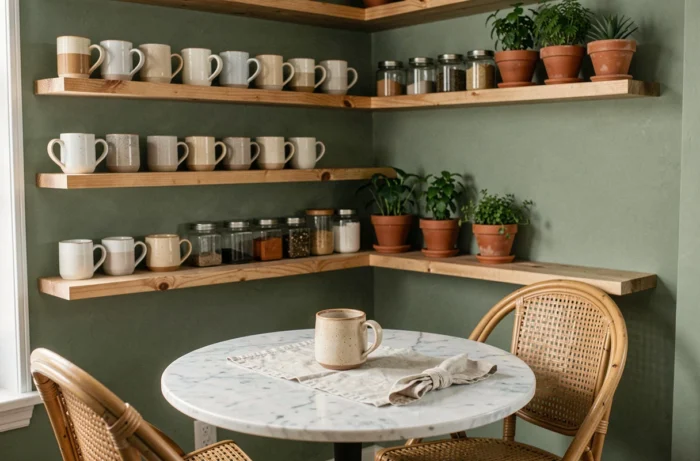
This phenomenon concretely alters layout choices. The walls of living rooms or offices become scenarized compositions. Open shelves replace closed storage, not out of a taste for disorder, but to offer a visually exploitable depth on screen.
We recommend thinking of each exposed wall as a framed shot: shelf height calibrated to the webcam angle, indirect lighting positioned to avoid shadows, and a coherent color palette between objects and wall coverings. This approach, far from being superficial, requires a technical reflection on proportions and light that mainstream home decor articles often overlook.
For those who wish to delve deeper into their layout choices room by room, it is possible to explore the home category on Breizheo and find additional resources on furniture and space organization.
Raw Materials and Wood Finishes: Technical Choices for a Trendy Interior
The return to raw materials is not just a passing trend. Wood, linen, and stone impose implementation constraints that the choice of laminate or vinyl does not require. Solid oak flooring treated with natural oil ages differently than a wood-look laminate floor: patina, maintenance, reaction to humidity—all diverge.
The trendy wood finishes in 2025 favor light shades and matte treatments. Vegetable oils (like Rubio Monocoat, often cited by industry professionals) provide a single-layer protection that preserves the feel of raw wood. In contrast, glossy polyurethane varnishes, which have long been dominant, are declining in interior renovation projects.
On the wall side, lime plasters and mineral paints are gaining ground. Their technical interest lies in their permeability to water vapor, a parameter not to be overlooked in older homes where moisture management affects comfort and the durability of coverings.
- Oiled solid wood for floors and furniture: favor local species (oak, ash) to limit logistical footprint and ensure compatibility with French hygrometric conditions.
- Natural coatings for walls: air lime regulates ambient humidity and accepts natural pigments for earthy tones or off-whites.
- Textiles made from raw fibers: linen, hemp, or untreated wool for household linens and curtains, with particular attention to weight for a proper drape.
Earthy Colors and Living Room Palette: Beyond Generic Beige
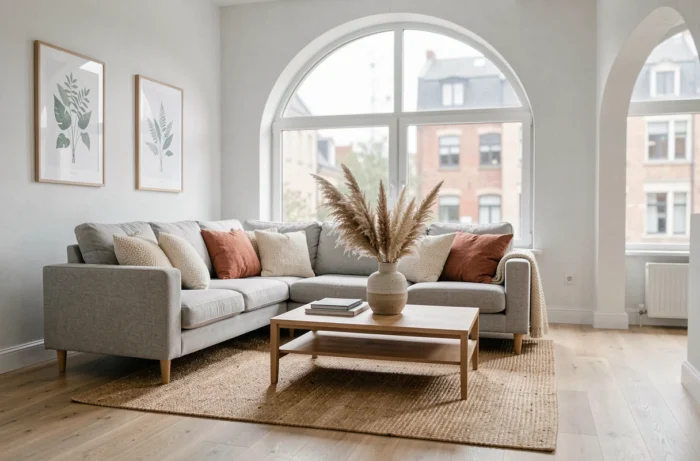
Earthy colors are not limited to a ubiquitous beige. We are observing a rise in ochres, sienna earths, and sage greens in recent projects, combined with deep blacks or muted blues as accents.
The technical challenge lies in the combination of shades with the room’s natural lighting. A warm ochre placed on a north wall, poorly lit, turns into a dull brown. The same ochre on a west wall, bathed in low-angle light at the end of the day, takes on a golden depth.
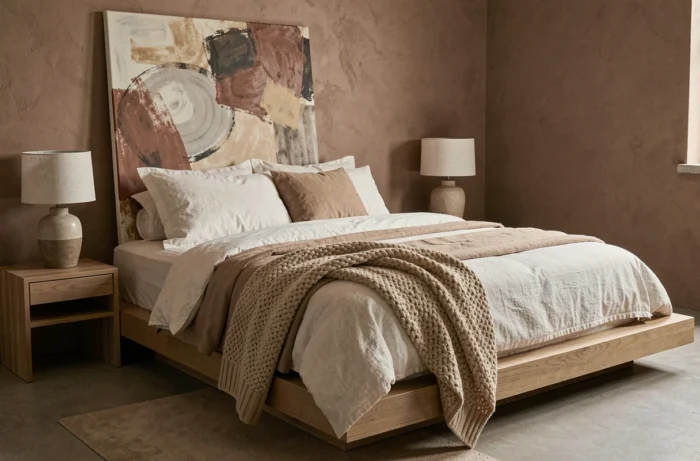
Before validating a trendy color for a living room or bedroom, we recommend systematically testing painted samples on at least three walls of different orientations, observed at various times of the day. Artificial lighting also radically alters the appearance: a cold temperature bulb (above 4,000 K) distorts earthy shades and gives them a grayish aspect.
The trend for 2025-2027 identified by several specialized sources points towards a priority given to authenticity. Monochromatic palettes in various saturations of the same hue are gradually replacing stark contrasts. This approach simplifies visual coherence between rooms while allowing for variations in intensity from one space to another.
Energy Renovation and Interior Decoration: Related Choices
The new requirements for the energy performance of homes are changing decor choices well beyond insulation. When an interior wall receives insulating cladding, the available thickness for the finishing covering decreases. This excludes certain thick coverings (solid paneling, facing bricks) or requires a reevaluation of the room’s proportions.
The installation of double-flow ventilation systems, common in recent renovations, introduces technical ducts that must be integrated into the false ceiling or casings. These elements condition the perceived ceiling height and, consequently, the style of light fixtures that can be considered.
- Before any decor project in a home undergoing energy renovation, obtain the technical plan of the claddings and ducts to anticipate volume losses.
- Prefer thin coverings compatible with interior insulation: sprayed coatings, technical paints, non-woven wallpapers.
- Adapt the choice of interior joinery (doors, baseboards) to the new dimensions after insulation to avoid costly adjustments.
The balance between aesthetics and thermal performance becomes a structuring issue in the decoration of a modern home. Ignoring this dimension risks having to redo the finishes twice or compromising the effectiveness of the insulating envelope due to poorly positioned openings.