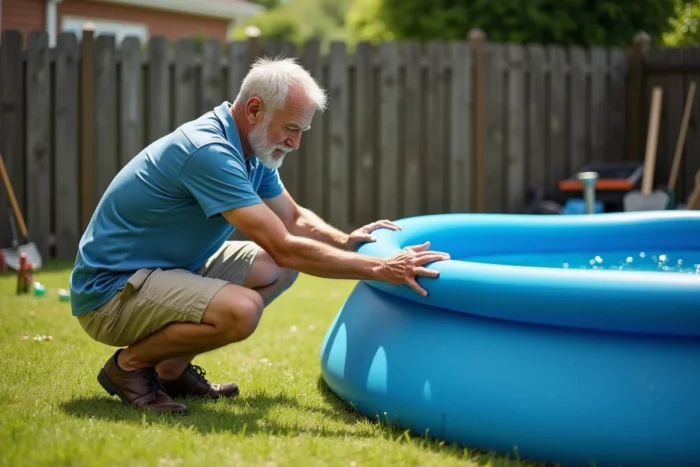
An above-ground pool that leans does not forgive: the deformation of the top ring accelerates in just a few days, the liner undergoes asymmetrical stresses, and the risk of rupture increases with each swim. We recommend intervening as soon as a level discrepancy is visible to the naked eye, without waiting for the structure to deform further.
Soil shrink-swell and above-ground pools: the ignored factor
Most guides attribute the tilting of an above-ground pool to an initial leveling defect. This is true in many cases, but since the repeated alternations of drought and heavy rain, a more insidious phenomenon has become widespread: shrink-swell of clay soils.
A clayey ground contracts in dry periods and then swells when water returns. Under the load of a filled pool, this movement is not uniform. Some areas compact more, creating a level differential that sometimes appears several weeks after installation.
The problem is that the ground continues to move throughout the summer. A pool placed on stable ground in June may lean in July after a rain episode followed by heat. On homeowner groups, several feedbacks describe exactly this scenario: the pool was level at installation, then began to lean during the season without any visible external element explaining it.
Before placing an above-ground pool on clay soil, we recommend checking the nature of the ground by digging about twenty centimeters deep. If the soil is sticky and cracks as it dries, a compacted sand bed alone will not be sufficient: it is necessary to consider a slab or rigid distribution plates to stabilize the base.
If you are looking to understand how to correct a leaning above-ground pool, the first step is to identify whether the ground itself is to blame before attempting a superficial adjustment.
Actual level tolerance for an above-ground pool: the rule of a few millimeters
Manufacturer instructions remain vague on the acceptable level discrepancy. Field feedback is more decisive: beyond a few millimeters of discrepancy along the entire length, problems begin. Specialized forums report that a realistic tolerance is around five millimeters maximum.
This threshold is surprising, but it is mechanically explained. On an above-ground pool, the top ring floats and maintains the shape of the pool. When the ground is not level, the water exerts asymmetrical lateral pressure on the liner. The lower side receives more load, the ring deforms, and the structure loses its circular or oval geometry.
The concrete consequences of even a moderate discrepancy:
- Premature wear of the liner at the low point, where tension is maximum, with a risk of micro-perforations at the folds
- Progressive deformation of the inflatable ring that no longer returns to its original shape after deflation
- Increased risk of tilting in case of sudden overloads (children jumping, gusts of wind, turbulence during a rough swim)
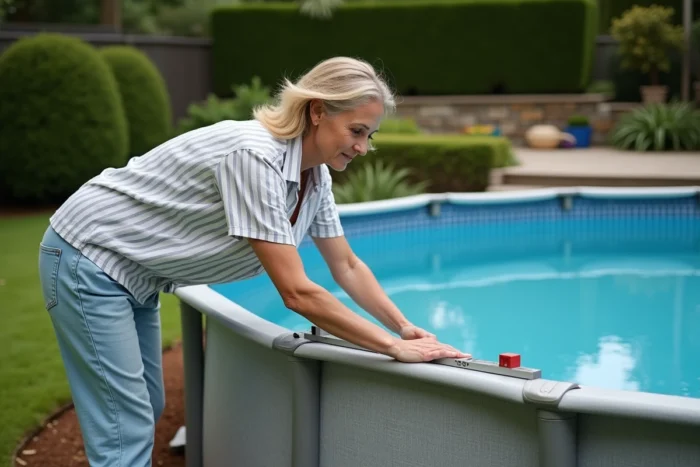
To achieve this precision, a bubble level placed on the ground is not enough. We use a minimum two-meter masonry level, moved in a star pattern across the entire base surface, supplemented by a laser level if the pool diameter exceeds three meters.
Adjustment protocol for an above-ground pool without complete draining
Completely emptying the pool to readjust the ground represents a considerable loss of water and additional mechanical stress on the liner. A partial adjustment is possible if the discrepancy remains moderate and the structure is not yet deformed.
Lower the water level before intervention
Empty the pool to about one-third of its height, using the drain plug or a sump pump. The goal is to sufficiently reduce lateral pressure to lift the low edge of the pool without forcing the liner.
Raise the low side with stable material
Slide high-density extruded polystyrene boards or rigid EVA foam slabs under the ground mat on the low side. Sand alone should be avoided for this spot adjustment: it migrates under load and recreates the differential in a few weeks.
Check the level after each addition, using the masonry level resting on the upper edge of the pool. The adjustment is done in successive passes of a few millimeters, not in a single intervention.
What requires a complete drain
If the discrepancy exceeds two to three centimeters, or if the ring shows visible deformation (one side significantly lower than the other with a marked fold on the liner), partial adjustment is no longer sufficient. It is necessary to drain, disassemble, rework the ground, and reposition the pool.
Prepare the ground to prevent recurrence on unstable soil
A successful adjustment is worthless if the ground continues to move. On clay or loose soil, preparation must go beyond a simple sand bed.
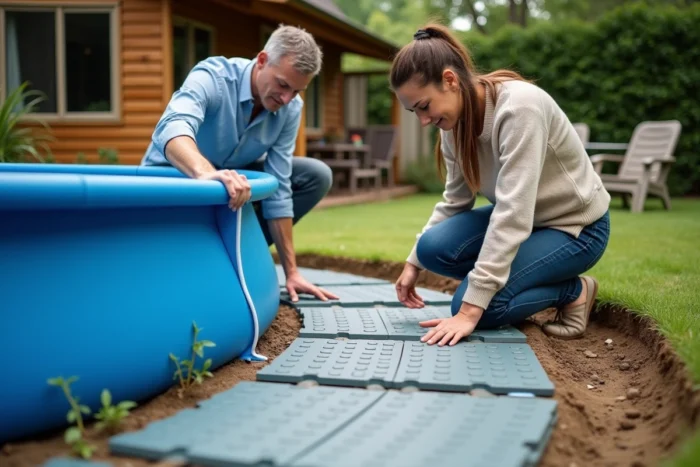
- Excavate at least fifteen centimeters, then lay a geotextile to separate the fill from the natural soil
- Fill with a compacted sand-gravel mixture in successive layers, each layer watered and compacted with a tamper or roller
- Place rigid distribution slabs (extruded polystyrene or polyethylene sheets) over the entire surface, not just under the edges
- Check the final level with the masonry level in a star pattern, then check again after a thorough watering of the fill to simulate a rain episode
The ground mat supplied with the pool does not replace this preparation. It protects the liner from roughness but has no load distribution or stabilization function.
On slightly sloped terrains, excavation must be done horizontally by digging the high side, never by backfilling the low side. Uncompacted backfill will settle under the weight of water and recreate the slope in a few days.
A final often overlooked point: the drainage of rainwater around the pool. If runoff accumulates on one side, it saturates the soil asymmetrically and restarts the subsidence process. A simple peripheral drain or a trench dug around the installation area is enough to prevent this problem.