How to measure the real contribution of a digital educational platform for students with dys disorders or learning difficulties? Maclasse 2026 is set in a context where inclusive education in France is evolving rapidly, with recently expanded provisions for secondary education and ongoing reassessment of medical-social budget allocations. The issue is no longer whether inclusion is desirable, but rather comparing the concrete levers that make it operational in the classroom.
Self-regulation mechanisms and dys disorders: what changes in 2026
General content on school inclusion often overlooks a structural evolution. Self-regulation mechanisms, initially reserved for students with ASD in primary school, have been updated to include other neurodevelopmental disorders, including dyslexia, dyspraxia, and dyscalculia.
The deployment is now expanded to middle and high schools, both general and vocational. For a dys student leaving primary school without a structured framework, this extension changes the prospects for schooling beyond CM2.
Each mechanism includes a dedicated room for self-regulation activities, designed for managing attention, cognitive load, and emotions. This material framework provides a direct complement to digital pedagogical adjustments like those offered by Maclasse 2026. An article gathering information on maclasse2026.fr and inclusivity details how the platform articulates its features with these new mechanisms.
The reassessment of financial allocations for these teams in a full year confirms a concrete budgetary commitment, not just declarative.
PAP, PPS, PPRE: comparison of support plans for dys students
Three administrative mechanisms govern the pedagogical support for students in difficulty or with disabilities. Their articulation with a digital tool like Maclasse 2026 directly depends on the chosen framework.
| Mechanism | Target Audience | Validation | Link with MDPH | Type of Adjustment |
|---|---|---|---|---|
| PAP (Personalized Support Plan) | Dys students without recognized disability | School doctor + teaching team | None | Pedagogical adjustments (extra time, adapted materials) |
| PPS (Personalized Schooling Project) | Students with recognized disabilities | MDPH | Mandatory | Human support (AESH), adapted materials, guidance |
| PPRE (Personalized Educational Success Program) | Students with temporary academic difficulties | Teaching team only | None | Targeted support, short-term objectives |
The PAP remains the most common framework for dys students without an MDPH file. It allows for the direct integration of digital tools into adjustments without going through a lengthy administrative procedure. In contrast, the PPS opens access to human support and specific materials that digital alone cannot replace.
The PPRE targets temporary difficulties and does not cover lasting disorders. A dyslexic student directed towards a simple PPRE risks not benefiting from sufficient adjustments over time.
Inclusive features of Maclasse 2026 for the mainstream classroom
The value of a platform like Maclasse 2026 lies in its ability to integrate into the daily life of the mainstream classroom, without removing the student from their group. Several features directly address the needs identified in the PAPs.
- Typographic and layout adaptation: specific fonts for dyslexia, adjustable spacing between lines and words, which reduces the visual decoding load for dyslexic students
- Audio reading of instructions: a student struggling to read a written statement can access the content orally, without constantly relying on the teacher or an AESH
- Individualized pacing exercises: each student progresses at their own pace, avoiding the dropout effect linked to the collective rhythm of the class
- Differentiated pedagogical monitoring: the teacher visualizes results by student and identifies blocking points without waiting for formal assessment
The digital tool does not replace human support, but it reduces dependence on an adult for every reading or instruction comprehension task. For a teacher managing a class of twenty-five students, three or four of whom have a PAP, this partial autonomy significantly changes group management.
Limitations to consider
A digital tool requires material access (tablets, computers) and a reliable connection. In under-equipped institutions, the benefit remains theoretical. Teacher training in the pedagogical use of these platforms also conditions their real effectiveness.
Without specific training, an inclusive tool becomes a simple support for traditional courses. Pedagogical differentiation does not occur merely by installing software.
Link between digital support and human support AESH
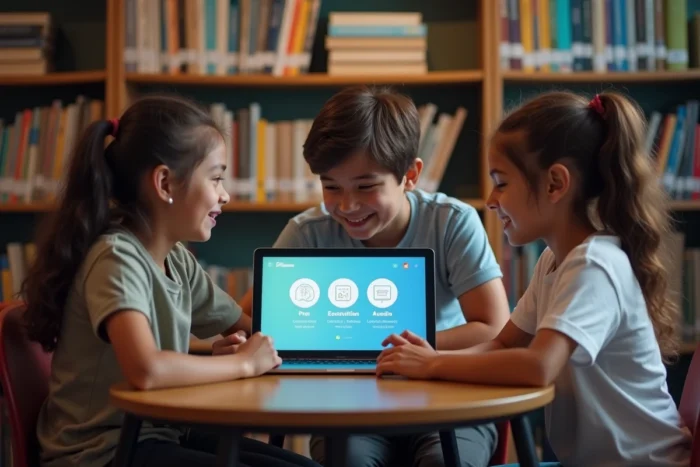
The question of the link between digital tools and AESH deserves to be raised without opposing the two. An AESH addresses dimensions that digital does not cover: real-time oral reformulation, emotional management, physical adaptation of the workstation.
However, digital frees up AESH time for high-value tasks. If the student accesses the instruction independently through audio reading, the support person can focus on methodological help or behavioral regulation.
This complementarity works provided that the PAP or PPS explicitly specifies how the digital tool articulates with human intervention. A plan that mentions “use of an adapted digital support” without detailing the modalities remains too vague to guide the teaching team on a daily basis.
The expansion of self-regulation mechanisms to secondary education and the reassessment of medical-social budgets create a more favorable framework than two years ago. The key takeaway remains this: a well-formulated adjustment in a PAP or PPS determines the effectiveness of any tool, digital or otherwise.
Maclasse 2026 provides relevant features for dys students in mainstream classrooms, but their impact depends on the precision of the support plan and the training of the educational team implementing them.