
Planing oak is not just a cosmetic finish. It is a budget item that can represent several hundred euros per cubic meter, and it alters the usable dimensions of each piece. Before placing an order, one must consider the actual cost per cubic meter installed, not just the raw catalog price.
Additional cost of planing per cubic meter of oak: the items that quotes mask
On a sawmill invoice, the price of raw oak lumber reflects only part of the final cost. Two additional lines transform the budget: drying and planing. According to updated L-P-G rates, drying adds about 170 euros per cubic meter and planing can rise to 420 euros per cubic meter for joinery sections.
In other words, a basic quality structural oak is around 750 euros per cubic meter. A planed oak of joinery quality exceeds double that. Planing is the most underestimated budget line in an oak project.
We observe that many quotes group drying and planing into a “finishing” package, which prevents negotiating each item separately. Demand a line-by-line breakdown. This is the only way to compare offers between sawmills and decide if planing is worth the cost for your specific use. To delve deeper into the choice between raw and planed dimensions on Jardinier.net, price differences are detailed by usage category.
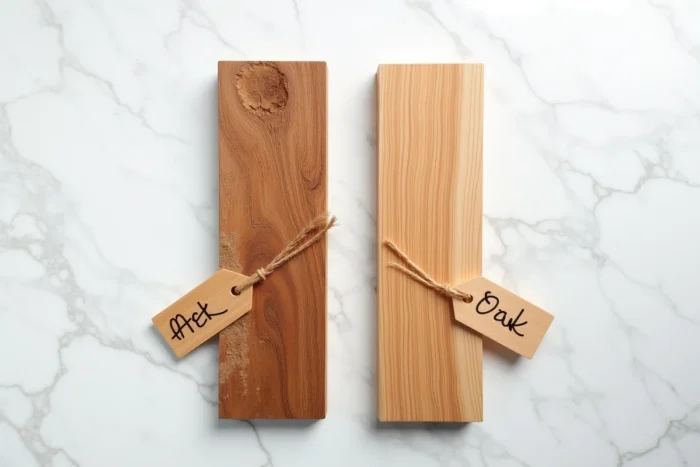
Material loss during planing: impact on the usable section of oak
Planing removes between 3 and 5 mm from each side. On a piece of oak with a raw thickness of 50 mm, you end up with a finished section of 40 to 44 mm. This loss is not trivial: it alters span calculations in framing and the available thicknesses in cabinetry.
Specifically, if your project requires a finished section of 60 mm, you must order raw material in at least 70 mm. The upgrade in raw thickness generates a direct additional cost, on top of the planing itself. The raw dimension always dictates the finished dimension, never the other way around.
When material loss makes raw more cost-effective
In a traditional frame where beams remain hidden in an attic, the roughness of raw lumber has no functional impact. The raw wood retains its maximum dimensions, allowing for a downgrade in section classification without compromising mechanical strength.
In exterior cladding, the question arises differently. Raw lumber adheres better to surface treatments (stain, saturator) due to its natural roughness. Planed wood offers a smoother finish, but the adhesion of treatment products decreases if the surface is not sanded beforehand.
Raw or planed oak depending on the type of project: technical selection criteria
The choice is not just about aesthetic preference. Three technical parameters guide the decision.
- Required dimensional tolerance: a mortise and tenon joint or furniture assembly requires parallel faces and right angles. Planed wood is necessary, unless you have a jointer-planer in the workshop.
- Exposure to the elements: for cladding or decking, raw lumber withstands moisture cycles better because its open fibers facilitate evaporation. Planed wood, with its crushed pores on the surface, dries more slowly after rain.
- Overall project budget: on a volume of several cubic meters (framing, structure), the savings from raw wood can reach several thousand euros. On small quantities (shelf, shelf), the difference becomes marginal, and the time savings from planed wood compensates.

The specific case of oak for furniture and countertops
In cabinetry, we almost always recommend raw oak purchased in logs, then planed and smoothed in the workshop. The reason is simple: sawmill planed wood is calibrated to a standard thickness. Your furniture pieces rarely require this exact thickness, and you will lose more material during final machining.
Buying raw logs also allows you to select the cuts based on the grain of the wood, the presence of sapwood, and the width of the growth rings. This selection is impossible with pre-cut planed wood in standardized boards.
Drying raw oak: a parameter that the price per cubic meter does not reveal
Raw oak sold “freshly sawn” contains moisture levels much higher than that of wood ready to install. Without controlled drying, raw oak warps, splits, and twists. Natural drying takes about a year per centimeter of thickness. Artificial drying in a kiln reduces this time to a few weeks but adds a significant cost per cubic meter.
Planed oak delivered by a sawmill is generally already dried, which explains part of its higher price. When purchasing raw wood, you must factor in the cost and time of drying in your budget. Otherwise, the raw/planed comparison is skewed from the start.
How to check the moisture content before purchase
A pin-type hygrometer costs a few dozen euros and prevents costly mistakes. For oak intended for indoor use, aim for a moisture content of 8 to 12%. For cladding or ventilated framing, a moisture content of 18 to 22% remains acceptable. Always buy knowing the measured moisture content, not what is stated on the delivery note.
The choice between raw and planed oak boils down to an equation specific to each project: ordered volume, required finished section, available workshop equipment, and room exposure. On a framing site, raw remains the most rational solution. For fine cabinetry in small quantities, planed wood saves time without excessively inflating the bill. In any case, request a quote with drying, planing, and delivery itemized line by line.