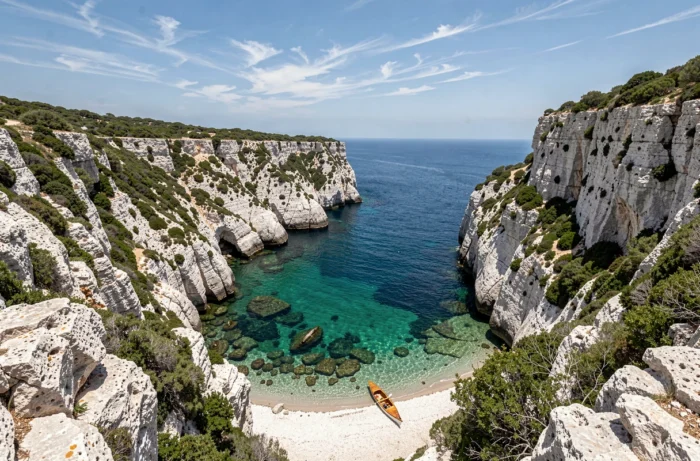
The calanque of la Vesse, located in the municipality of Rove, mainly attracts divers and hikers looking for a quick entry point to the sea from the Côte Bleue. However, with the summer closures of the massifs, the tightening of fines for swimming in prohibited areas, and parking constraints, preparing properly radically changes the experience. What concrete parameters distinguish this calanque from its neighbors, and which ones risk spoiling the outing?
Summer Regulations on the Côte Bleue: What Has Changed Since 2026
Competing guides extensively detail the location and charm of the site. However, they overlook two regulatory developments that practically alter the visit.
Since August 2, 2026, the fine for swimming in a prohibited area has increased from 38 to 68 euros (3rd class offense). The calanque of la Vesse does not have a beach with official health monitoring: in the event of a temporary municipal or prefectural order (pollution, swell, construction), entering the water exposes one to this doubled sanction.
Access to the Mediterranean massifs is now managed day by day via an official fire risk map updated every evening for the next day. The levels go up to “exceptional” risk, where access is completely prohibited, including for pedestrians. On red days, the paths leading to la Vesse from Niolon or from the customs path are closed. Some prefectures specify that this prohibition also applies to landing by sea.
To learn everything about the calanque of la Vesse before you go, it is useful to cross-reference this regulatory information with the day’s weather conditions.

Access to the calanque of la Vesse: Comparison of Car, Train, and Path
Three means of access coexist, with very different constraints depending on the season and the day of the week.
| Access Mode | Time from Marseille Center | Main Constraint | Proximity to Water |
|---|---|---|---|
| Car (D568 then descent towards Rove) | About 30 minutes | Very limited parking spaces, full on weekends from morning | Just a few meters between the parking and the sea |
| Côte Bleue Train (Niolon stop) | Variable depending on the schedule | Reduced frequency, then walk to la Vesse | About 5 minutes walking via the coastal path |
| Coastal Path (customs path) | Depends on the starting point | Closed in case of high fire risk | Direct arrival at the cove |
Parking is the major asset of la Vesse compared to other calanques of the Côte Bleue. Parking is just a few meters from the water, making it a prime spot for divers carrying heavy equipment (tanks, regulators, wetsuits). However, the capacity is very low: in summer, arriving after 9 AM on a Saturday often means turning back.
The Côte Bleue train passes over the viaduct that overlooks the calanque. The Niolon stop is the closest. From there, the coastal path reaches la Vesse in just a few minutes. This option eliminates the parking problem but requires checking return schedules, as service is irregular.
Diving and Swimming at la Vesse: What the Site Really Offers
The calanque of la Vesse is not a typical family swimming spot. The cove is small, exposed to the open sea, and the bottom consists of rocks and pebbles, not sand. The main interest of the site focuses on two activities.
- Scuba diving: the proximity of the parking allows for gearing up and entering the water without carrying equipment. The rocky bottoms host Mediterranean marine life accessible from the first few meters of depth.
- Spearfishing: the site is frequented by regular hunters who appreciate the clear waters and the rocky formations close to the shore.
- Coastal hiking: from la Vesse, the customs path allows access to the wild calanque of Figuerolles on one side and Niolon on the other, offering views of the coastline and isolated coves.
For swimming, the waters are clear, but entering on the rocks requires suitable footwear. No supervision or lifeguard station on site. Families with young children will find a more suitable setting in Niolon, which has a small harbor and a more gradual access to the water.
Shacks and Viaduct of la Vesse: An Unusual Setting on the Côte Bleue
La Vesse does not resemble the wild calanques of the national park. Part of the site is concreted, with fishermen’s shacks tightly packed together. The railway viaduct that spans the calanque serves as an immediate visual landmark and gives the place a unique atmosphere, halfway between industrial heritage and coastal landscape.
This decor divides opinions. Visitors seeking a preserved natural setting will be disappointed by the concrete and constructions. Those who appreciate the ambiance of Mediterranean fishing ports will find a raw charm here. The shacks are not open to visitors: they are private properties used by local families for several generations.
The cove located after the islets, accessible on foot from the back of the calanque, offers a wilder setting. This is where the contrast with the concreted part becomes most apparent, with limestone rocks plunging directly into turquoise waters.
When to Visit the Calanque of la Vesse: Season and Time Slot
Autumn offers the best conditions: low fire risk, accessible parking, still warm waters. From September to November, closures of the massifs are rare, and attendance drops significantly compared to July-August.
In summer, checking the fire risk map the evening before is necessary. A day classified as red closes all access paths. The most reliable time slot remains early morning on weekdays, before the parking lot fills up.
The mistral wind makes the calanque impractical for swimming and diving: exposed to the open sea, la Vesse takes the swell head-on. Checking wind forecasts before traveling avoids an unnecessary trip from Marseille.