The letter K encompasses plants often unknown in France, originating from Asian, African, or North American floras. Their common point: names derived from Japanese, German, or Latin, and characteristics that make them useful in the garden in specific situations (acidic soil, drought, shade). This classification prioritizes the diversity of uses, ease of cultivation in the French climate, and the ornamental or fruit-bearing interest of each species.
1. Kniphofia (Kniphofia uvaria)
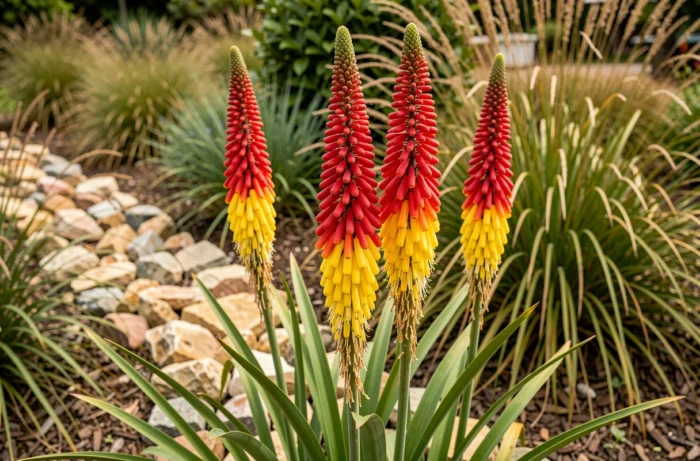
Kniphofia, sometimes called “Satan’s torch,” produces bicolored spikes of orange and yellow that peak between June and September. Native to the grasslands of South Africa, this perennial easily reaches a height of one meter.
Its success hinges on two words: well-drained soil and full sun. In heavy, wet soil during winter, the crown rots. A layer of gravel at the bottom of the planting hole usually solves the problem. Kniphofia adds a rare graphic verticality to a bed of low perennials.
Among the flowers or trees starting with k, kniphofia remains the one that attracts the most hummingbirds in gardens where these birds are present, and bees in temperate European climates.
2. Kaki (Diospyros kaki)
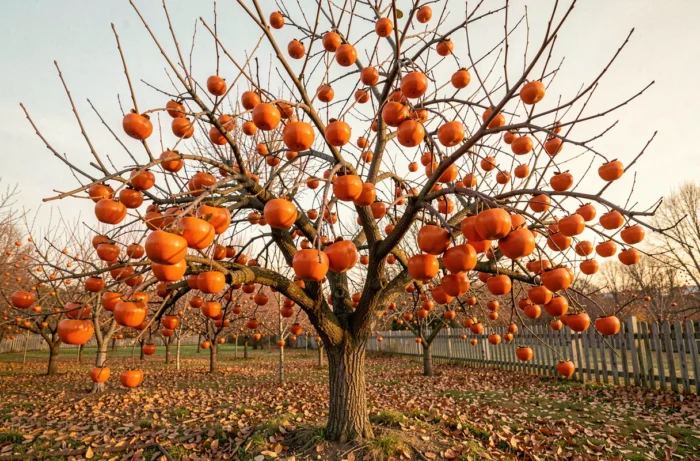
The kaki persimmon tree is no longer reserved for the south of France. The SNHF now considers it cultivable in the West, the Center, and the Paris region, with a hardiness reported between -15 °C and -20 °C depending on the varieties. Cultivars like ‘Tanenashi’ or other hardy selections have been spreading in French nurseries since 2024.
The kaki also stands out as a resilient fruit tree in the face of dry summers. It tolerates water stress well, provided it has deep soil. Its reddish-orange autumn foliage makes it a fully ornamental tree, well beyond its fruit-bearing interest.
3. Kalmia latifolia (Kalmia latifolia)
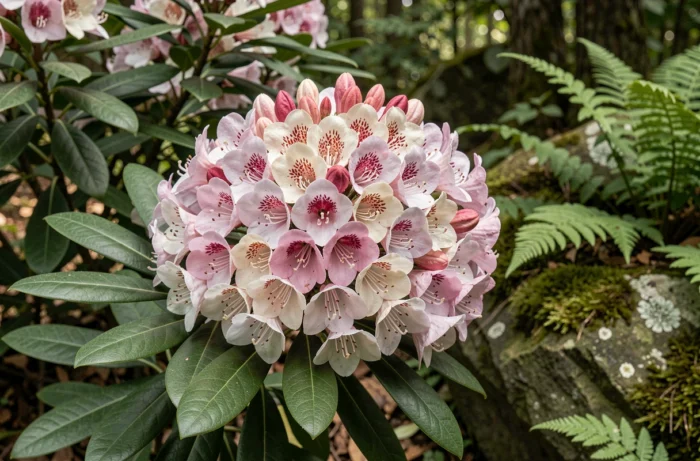
Kalmia, or mountain laurel, forms an evergreen shrub native to the eastern United States. Its geometrically shaped flowers, white to pink, appear in May-June. Each bud resembles a small plant origami.
All parts of kalmia are highly toxic. This constraint excludes its planting near children’s play areas or pastures. However, it excels in acidic undergrowth, where few shrubs bloom as generously. It requires heath soil and tolerates temperatures down to -20 °C.
4. Kerria japonica (Japanese Kerria)
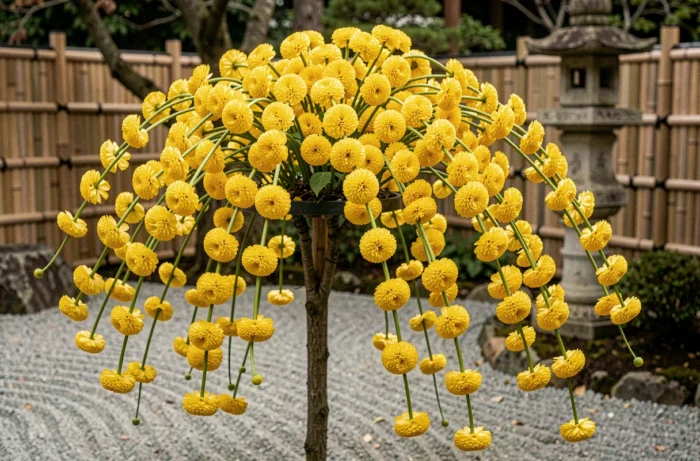
Japanese Kerria offers bright yellow pom-pom blooms starting in April, on arching bright green branches that remain decorative even in winter. It is one of the few shrubs that bloom abundantly in partial shade.
Its maintenance is limited to pruning after flowering to renew the branches. Kerria japonica tolerates almost all soils, including calcareous and poor soils. This versatility explains its frequent presence in urban gardens where light is lacking.
5. Knautia arvensis (Field Knautia)
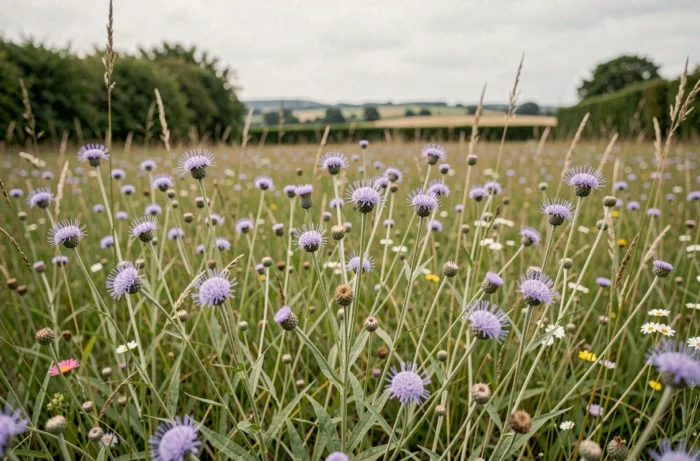
Field Knautia resembles a scabious and is distinguished by its flatter flower heads, in a strong lilac mauve. It blooms from June to September in dry meadows and calcareous slopes.
This nectar-rich perennial attracts butterflies and pollinators. It self-seeds spontaneously and is perfect for naturalistic gardens or flowering strips along vegetable plots. Its only flaw: a somewhat unruly habit that requires structuring neighbors to balance the bed.
6. Kalanchoë (Kalanchoe blossfeldiana)
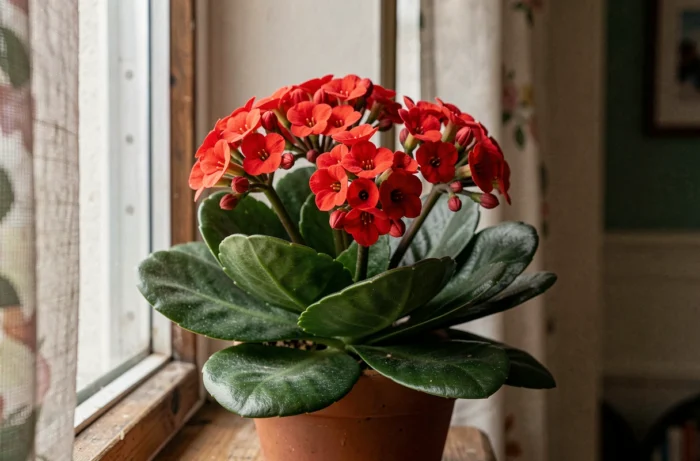
Kalanchoë is the best-selling indoor plant starting with K in France. Its tight clusters of small red, pink, yellow, or white flowers last several weeks without special care.
A moderate watering and bright indirect light are enough to keep this succulent healthy. To trigger a new bloom, it needs to be subjected to long nights (at least fourteen hours of darkness) for six weeks. Without this manipulation, the plant remains green but does not re-bloom.
7. Kolkwitzia amabilis (Beauty Bush)
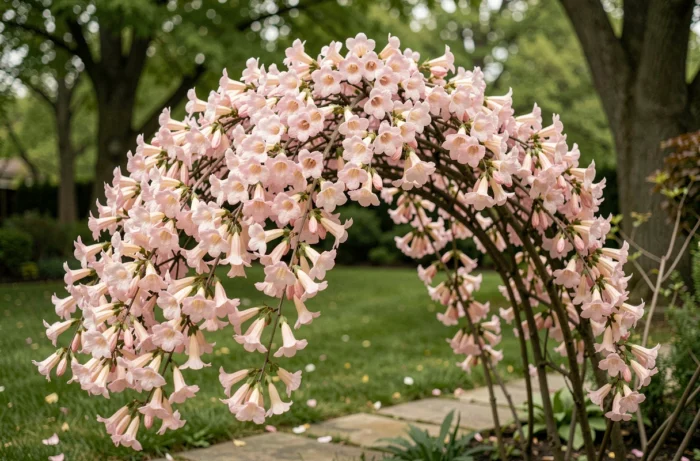
Kolkwitzia deserves its nickname “beauty bush.” In May-June, its branches are covered with pink bells with yellow throats, creating a spectacular floral cascading effect.
This deciduous shrub reaches two to three meters in height. It prefers full sun and tolerates ordinary soils, even calcareous ones. A rejuvenation pruning every three to four years, removing old wood at the base, maintains dense flowering without heavy intervention.
8. Kentranthus (Centranthus ruber)
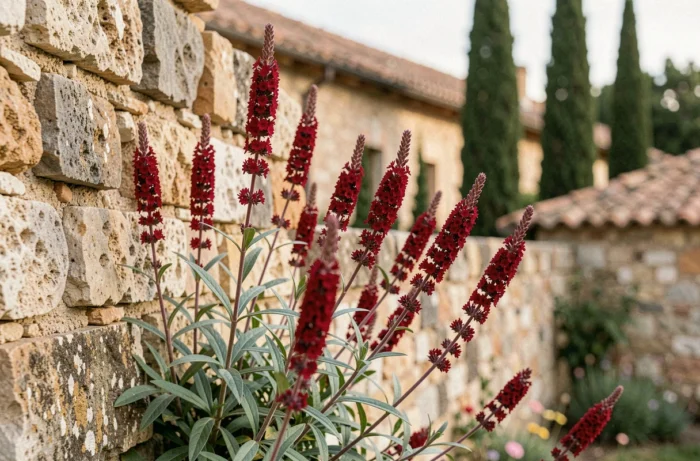
Red valerian colonizes old walls, stony slopes, and the most inhospitable soils of the Mediterranean region. Its clusters of red, pink, or white flowers appear from May to October, an uncommon flowering duration.
Kentranthus self-seeds abundantly, sometimes too much. In a structured garden, it is necessary to cut the faded flower stems before they set seed. In return, it requires neither watering nor fertilizer and massively attracts butterflies.
9. Koelreuteria paniculata (Golden Rain Tree)
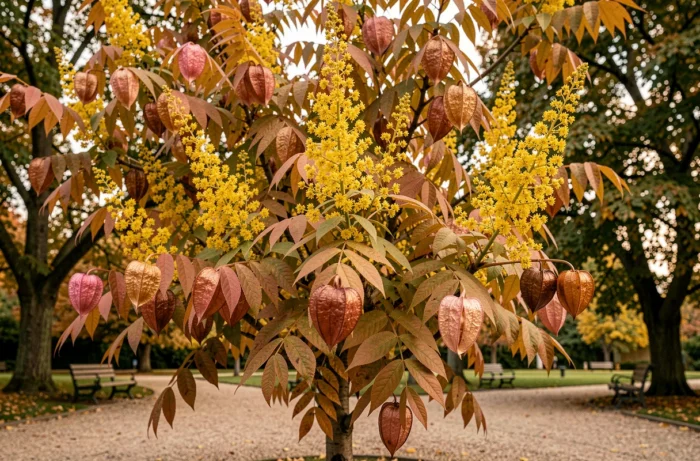
The Golden Rain Tree is a medium-sized tree, ideal for city gardens. Its clusters of yellow flowers bloom in July, followed by papery lantern-shaped capsules that persist until autumn.
- Resistant to urban drought and air pollution, making it a popular street tree
- Compound foliage turns golden yellow in autumn, extending its decorative interest
- Moderate growth and natural rounded shape that limits maintenance pruning
10. Kiwi (Actinidia chinensis)
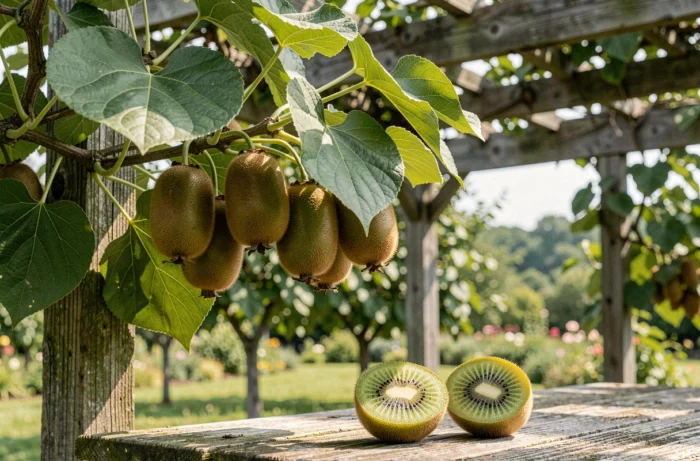
The kiwi is a vigorous vine that requires a sturdy support (pergola, trellis, taut wire). To produce fruit, at least one male plant must be planted for every five to six female plants, except with self-fertile varieties like ‘Jenny’.
The plant prefers acidic to neutral soil, rich in organic matter, and is sensitive to late spring frosts that scorch young shoots. In a suitable climate, harvesting occurs in autumn, before the first frosts. The kiwi remains one of the few climbing fruit trees capable of covering a facade while producing several kilograms of fruit per season.
These ten plants cover very different cultivation situations, from the Mediterranean dry wall to acidic undergrowth, from urban terraces to open-ground orchards. The choice is primarily based on three criteria: available exposure, soil type, and local hardiness. A kalmia planted in calcareous soil or a kniphofia in waterlogged soil will not survive, regardless of their beauty in the catalog.