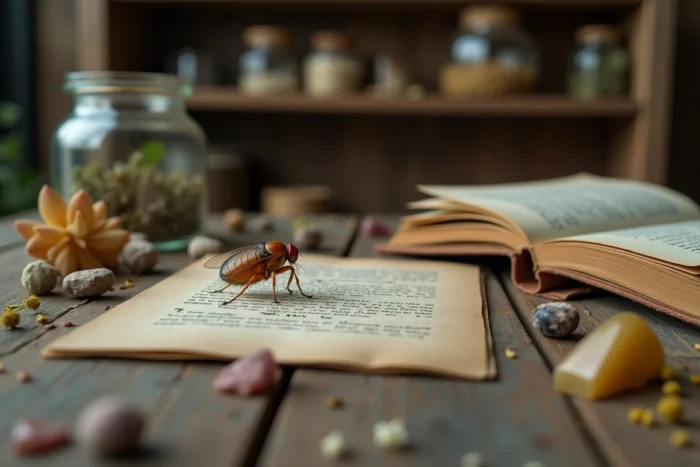
Fleas are part of those parasites that provoke an immediate reflex of disgust. Tiny, voracious, capable of jumping dozens of times their own size, they colonize our pets and sometimes our homes with formidable efficiency. Their presence in symbolic and spiritual traditions is less documented compared to other insects like the butterfly or ladybug, but several esoteric currents attribute specific meanings to them, often related to irritation, vigilance, and resilience.
Flea and language: when a parasite becomes a warning signal
Before addressing the spiritual dimension, a detour through the French language sheds light on how the flea has embedded itself in our collective imagination. The expression “mettre la puce à l’oreille” directly links this insect to the idea of suspicion, of budding doubt, of a mental alarm signal that must be heeded.
Francophone linguists have analyzed this expression and confirm that it refers to heightened vigilance, an intuition manifested by an apparently trivial detail. The flea, in this context, is not a noble symbol. It acts as a prick of conscience, an unpleasant reminder that one would prefer to ignore.
This link between the flea and intuition is found in contemporary esotericism, where the insect is increasingly presented as a symbol of intuitive alertness. Those seeking to understand the spiritual meaning of fleas often encounter this central idea: the flea draws attention to what we refuse to see, a toxic relational situation, an environment that drains energy, an imbalance tolerated out of habit.
The paradox is interesting: an animal so small and considered harmful carries a message that more “respectable” insects do not convey with the same insistence.

Spiritual symbolism of fleas: resilience and energy parasitism
Several authors specializing in animal symbolism attribute three recurring axes of interpretation to the flea.
Agility and survival in hostile environments
The flea is among the insects capable of thriving in conditions that most organisms would not tolerate. This radical adaptability has led some authors, such as those from the Roselalune site, to categorize the flea among the symbols of resilience and survival in extreme conditions. The associated keywords are “agility, survival, irritation.”
On a spiritual level, encountering a flea repeatedly or experiencing a sudden infestation would serve as a mirror: the current situation demands adaptation, flexibility, and not remaining stuck in the face of adversity.
Irritation as a catalyst for change
The itch caused by a flea bite does not endanger life, but it is impossible to ignore. It is precisely this characteristic that symbolism retains. Persistent irritation represents a necessary discomfort that pushes one to act rather than to endure.
In dream psychoanalysis, the flea appears as a disruptive element signaling repressed annoyance, unexpressed frustration. Tristan-Frédéric Moir’s dream dictionary associates the flea with this realm of productive irritation.
Parasitism and toxic relationships
The flea feeds on the blood of its host. This biological reality translates directly into the symbolic realm: it points to relationships or situations that drain vital energy without reciprocity. Here are the signs that some practitioners associate with this message:
- A person in the vicinity who constantly demands without ever giving back, creating a noticeable energy imbalance
- A professional or domestic environment that exhausts resources without offering satisfaction or recognition
- Habits or repetitive patterns that “suck” time and energy, like an invisible parasite embedded in daily life
The flea, in this reading, serves as a direct reminder: identify what feeds off you and rid yourself of it.
Flea infestation and esoteric interpretation: between witchcraft and energy cleansing
A lesser-known angle concerns the interpretation of sudden infestations in certain currents of witchcraft and Western spirituality. Sophia Mézières, in her work on the symbolism of harmful insects in witchcraft, includes the flea in the same category as bedbugs, lice, and flies.
According to this framework, a sudden proliferation of parasites without apparent cause can be interpreted as a sign of an energetic conflict, a directed envy against the home, or disturbed energy fields. The flea is not the cause of the problem; it would be the visible symptom.
Field reports vary on this point. Some practitioners see it as a clear signal requiring a ritual of purification of the living space. Others consider that this interpretation is more about psychological projection than a measurable energetic reality. The available data do not allow for a definitive conclusion between these two readings.
What remains constant across different approaches is the idea that the flea acts as a revealer of imbalances in the intimate environment. Whether one chooses an energetic or psychological explanation, the message converges: something in the personal space requires immediate attention.

Flea as a totem animal: an unexpected spiritual guide
In shamanic and neo-shamanic traditions, every animal can become a guide or totem. The flea, despite its size and reputation, does not escape this logic. Its teachings differ from those of more valued animals:
- The ability to make the most of minimal resources, echoing frugality and resourcefulness
- The art of going unnoticed while having a disproportionate impact on its environment
- Persistence in the face of rejection, as the flea returns despite all treatments if conditions are favorable
This last point is striking. The flea as a totem does not teach greatness or power. It teaches that tenacity and adaptability matter more than size or prestige. A message that may not be glamorous, but is hard to contest on a biological level.
The fact that “puce” is also an affectionate term in French (“ma puce”) adds a layer of complexity to its symbolism. The most irritating insect in domestic life is also a tender word, associated with protective smallness and attachment. This duality reflects the very nature of the spiritual message attributed to fleas: what disturbs the most is sometimes what deserves the most attention.
The next time a flea manifests insistently in your environment or in your dreams, the practical reflex (pest control, cleaning the house) remains a priority. The symbolic reading comes afterward, as a complementary lens to interrogate what, in your life, itches relentlessly and awaits to be finally confronted.