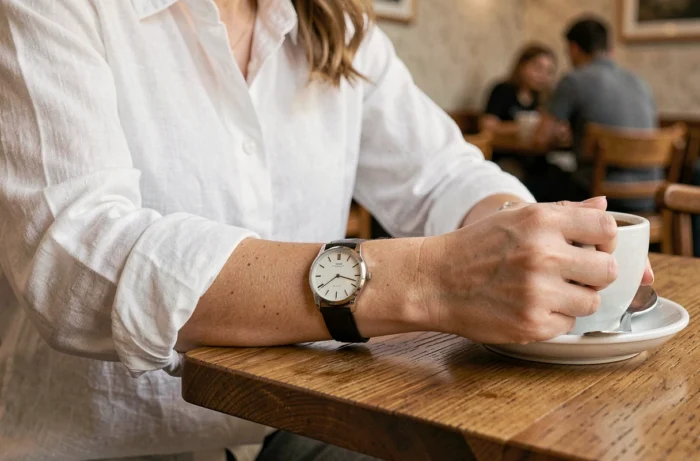
The dial turned towards the body rather than outward: this gesture is intriguing, but it spreads well beyond the military circles where it originated. Wearing the watch towards the inside of the wrist responds to specific constraints, from managing light reflections to optimizing health sensors embedded in smartwatches. Understanding this phenomenon requires untangling three threads: tactical heritage, the ergonomics of wearables, and individual habits of reading time.
Reflections, luminescence, and discretion: the tactical origin of the reversed wear
Competitors discussing the left/right choice overlook a central technical point. In operational units, the watch oriented towards the inside of the wrist primarily serves to contain the luminous trace of the dial. A glass that captures a ray of sunlight or a backlit screen visible from a distance compromises discretion during night operations or surveillance.
When the dial faces the body, the luminescence (hands treated with tritium, phosphorescent indices) and any backlighting are directed towards the wearer. The gesture of checking the time remains possible with a simple tilt of the wrist, without exposing a light source outward. This protocol is still included in recommendations for choosing and using a tactical watch.
The choice to wear a watch on the inside of the wrist goes beyond purely military contexts. Private security professionals, field photographers, or mountain guides adopt this positioning for the same reasons: to limit stray reflections and protect the glass from frontal shocks during equipment handling.

Smartwatch and sensors on the wrist: the health factor
The rise of smartwatches has reignited the question of wrist placement from an unexpected angle. Optical heart rate sensors (photoplethysmography) and, more recently, oscillometric blood pressure sensors work by emitting light through the skin to measure blood flow.
The quality of contact between the back of the case and the skin directly influences the reliability of the measurements. Wearing the watch towards the inside of the wrist places the sensor on an area where the skin is thinner and where wrist movements detach it less from the case. Several activity tracker manufacturers actually recommend adjusting placement based on the activity being performed.
Measurement accuracy based on positioning
Field feedback varies on this point. Some studies on wearables show that the inner wrist offers a more stable skin contact during physical exertion, which reduces motion artifacts in heart rate readings. In contrast, for step counting, the classic position (dial facing outward) seems equivalent.
Watches equipped with built-in blood pressure monitors, such as recent models with miniaturized oscillometric cuffs, pose an additional constraint. The sensor must be aligned with the radial artery, and the reversed wear may facilitate this alignment for some users depending on their wrist morphology.
- The skin-sensor contact is more consistent on the inner face, where tendons move less during wrist flexions
- Tattoos and hair, more present on the outer face for some individuals, disrupt the optical reading of the sensors
- Wearing it inside limits the screen’s exposure to direct sunlight, reducing reading difficulties outdoors
Reversed watch wear and daily comfort
Outside of professional and sports contexts, more mundane reasons explain the growing adoption of this gesture. The first is the protection of the case and glass against shocks. Anyone who works with their hands (carpenter, mechanic, chef) knows that a dial exposed outward takes hits against work surfaces. Turning it inward reduces this risk without having to remove the watch.
The second reason relates to reading ergonomics. Checking the time by slightly turning the wrist towards oneself creates a more natural movement for certain body types, especially when the arms are occupied (holding a steering wheel, grasping a tool). The dial is then readable without a complete rotation of the forearm.

A social signal that evolves
The reversed wear has long been associated with the military world or perceived as an eccentricity. This perception is changing as smartwatches normalize various placements on the wrist. The Apple Watch actually offers a software setting for dial orientation to adapt to reversed wear, indicating that manufacturers are incorporating this practice into their design.
The psychological dimension is not trivial. Some wearers report that keeping the dial turned towards themselves transforms the watch into a strictly personal tool, less exposed to the gaze of others. Checking the time becomes an intimate gesture rather than a visible signal.
Limitations and precautions for wearing a watch towards the inside
This positioning is not universal. Several constraints deserve to be considered before changing habits.
- The crown, located on the right side of the case on most mechanical models, can press against the back of the hand and hinder wrist flexion in the reversed position
- Steel bracelets with deploying clasps adapt less well to inside wear than flexible rubber or textile straps
- On some smartwatches, the gyroscope and accelerometer are calibrated for standard wear, and reversing the orientation without modifying the software settings skews motion detection
Checking the software compatibility of the smartwatch before reversing the wear remains the simplest precaution to apply. On mechanical models, trying the positioning for a few days with different types of straps allows for identifying friction points.
Wearing the watch towards the inside of the wrist is neither a passing trend nor a simple fixed military legacy. It responds to concrete needs for light discretion, case protection, and optimization of health sensors. The only variable that matters remains the actual comfort of the wearer, tested over several days and not decided on a whim.